
Deadlines at a glance
What counts as an e-invoice
Exceptions
Checklist: what your ERP must handle
Outgoing invoices
Incoming invoices
Archive
What happens if an invoice is wrong
How ready is the Mittelstand?
Outlook: ViDA from 2030
Common myths
We help with the switch
FAQ
When does the 2027 e-invoicing obligation start in Germany?
What is the difference between XRechnung and ZUGFeRD?
Is Peppol mandatory for B2B invoices in Germany?
How long must e-invoices be kept?
What happens if I still send PDF invoices in 2027?
Sources
E-Invoicing in Germany 2027: What Your ERP Must Handle from 1 January – A Checklist for XRechnung and ZUGFeRD

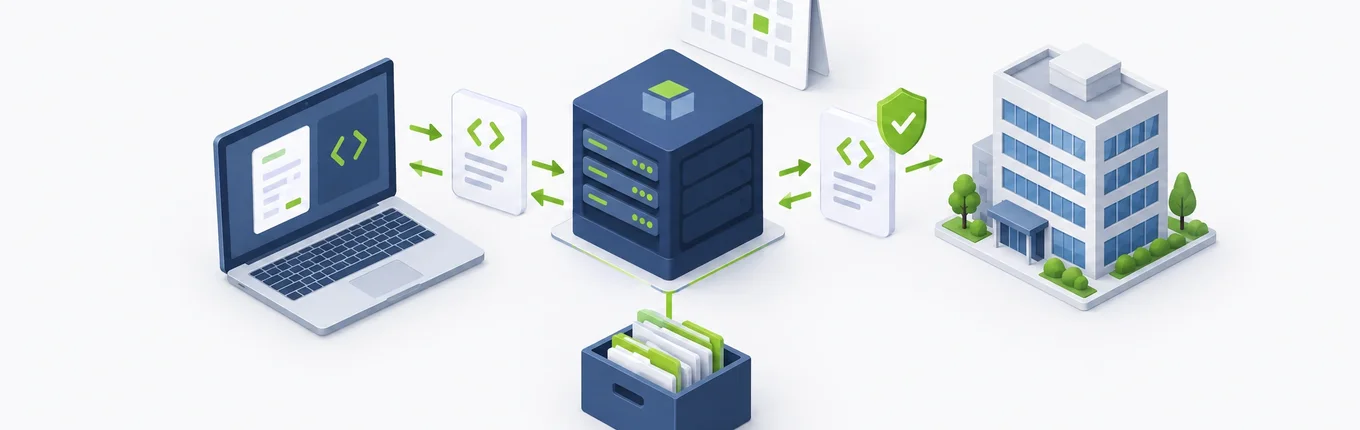
Short answer (updated October 2026). Since 1 January 2025, every business in Germany must be able to receive e-invoices. From 1 January 2027, businesses whose total turnover in 2026 exceeded €800,000 must issue e-invoices for supplies to other domestic businesses: XRechnung or ZUGFeRD from version 2.0.1 (except the MINIMUM and BASIC-WL profiles). Smaller businesses and EDI procedures have until the end of 2027; from 1 January 2028 the obligation applies to everyone. A PDF sent by email is not an e-invoice. What counts is the date of supply, not the invoice date. For your ERP this means: generate and validate structured invoices, receive XRechnung in both syntaxes (UBL and CII), and archive the XML unchanged for eight years.
This article summarises the rules as set out in the German Federal Ministry of Finance (BMF) letter of 15 October 2025 and the ministry's FAQ (as of March 2026), and turns them into a technical checklist for your ERP. It is not tax advice.
Deadlines at a glance

| Supply made | Receiving | Issuing |
|---|---|---|
| since 1 January 2025 | Mandatory for all businesses, including small businesses (Kleinunternehmer) | Paper allowed; PDF and other electronic formats only with the recipient's consent |
| in 2027 | Mandatory for all | Total turnover in 2026 above €800,000: e-invoice. Up to €800,000: paper or (with consent) PDF still allowed. EDI not based on EN 16931 allowed for everyone with consent |
| from 1 January 2028 | Mandatory for all | E-invoice for everyone, no transitional rules left |
Three details decide whether you are affected in 2027 (§ 27(38) UStG, BMF FAQ):
- The threshold is the previous year's total turnover (Gesamtumsatz) under § 19(2) of the VAT Act, so 2026 for the year 2027. It is calculated on amounts received; certain VAT-exempt turnover and sales of fixed assets are excluded (§ 19 UStG). It is neither profit nor current-year turnover.
- The date of supply counts. A service delivered in December 2026 and invoiced in January 2027 still falls under the old rules.
- The obligation covers domestic supplies between businesses. Invoices to consumers are not affected.
There is no postponement. The BMF letter of 15 October 2025 confirmed the dates, and the FAQ were updated in March 2026 without changes. The German crafts association ZDH has asked for an extension, but as of October 2026 there is no bill. For tax groups (Organschaft) and new businesses, check how the threshold applies with your tax adviser.
What counts as an e-invoice
An e-invoice is issued, transmitted and received in a structured format that allows electronic processing and complies with the European standard EN 16931 (§ 14(1) UStG).
| Format | E-invoice? | Notes |
|---|---|---|
| XRechnung (UBL or CII) | Yes | Current version 3.0.2; XRechnung 4.0 is out as a pre-release, the final version is expected in spring 2027 (KoSIT) |
| ZUGFeRD / Factur-X from 2.0.1 | Yes, except MINIMUM and BASIC-WL | PDF with embedded XML; current version ZUGFeRD 2.5.2 (FeRD) |
| EDI | Yes, if all data can be extracted into EN 16931 without loss | Other EDI formats allowed with consent until the end of 2027 |
| PDF, Word, scan | No | Counts as an "other invoice" (sonstige Rechnung) |
Two rules from the BMF letter are often missed:
- All mandatory details belong in the structured part. A reference to an attachment or a link is not enough.
- In ZUGFeRD, the XML prevails. Input VAT can only be deducted on the basis of the structured part. If the PDF differs, it may count as a second invoice (§ 14c UStG).
Exceptions
An "other invoice" (paper or PDF) remains permanently allowed for:
- small-amount invoices up to €250 gross (§ 33 UStDV);
- tickets (§ 34 UStDV);
- invoices from small businesses under the Kleinunternehmer scheme (§ 34a UStDV);
- supplies to private individuals and many VAT-exempt supplies.
Small businesses must still be able to receive e-invoices. A business that opts into standard VAT taxation must issue e-invoices from then on.
Checklist: what your ERP must handle
The law prescribes no transmission channel: email, a portal, an API or shared storage are all allowed. Peppol is not mandatory for B2B, and a Leitweg-ID is only needed for invoices to public authorities. The real work is in the data and the process.

Outgoing invoices
- The XML is generated from the accounting data, not from the PDF. XML extracted from a PDF afterwards inherits its errors.
- Master data is complete: VAT ID or tax number, date or period of supply, VAT rate and exemption reason per line, payment terms. For the buyer reference (BT-10), a placeholder "-" is enough in B2B.
- Every invoice is validated before sending, for example with the open-source KoSIT validator. The BMF recommends keeping the validation report.
- Format and channel are stored per customer: XRechnung or ZUGFeRD, email address, portal or Peppol ID.
- Credit notes and corrections are also sent as e-invoices and refer clearly to the original invoice.
- Advance and partial invoices follow the date of supply, so the ERP must know it for every invoice.
Incoming invoices
- A channel for incoming XML is set up, for example a dedicated mailbox from which the system collects files automatically.
- The system reads both XRechnung syntaxes, UBL and CII, and extracts the XML from ZUGFeRD PDFs. Not every standard system does both: according to its documentation, Microsoft Dynamics 365 Business Central reads XRechnung in UBL only (Microsoft Learn).
- There is a readable view. Accounting staff cannot read raw XML; the system must render it.
- Checks go beyond the validator. A green validation result only means the file is technically correct. Whether service, quantity and price are right is still for accounting to check, ideally by matching against the purchase order and goods receipt.
- Incoming invoices are matched and posted automatically: supplier, purchase order, cost centre, approval workflow.
Archive
- The XML is kept unchanged for eight years (§ 14b UStG, § 147 AO). Since the GoBD amendment of July 2025, the XML alone is sufficient; the PDF of a ZUGFeRD invoice only has to be kept if it contains additional tax-relevant information (BMF, GoBD amendment). A conversion, for example to TIFF, must not replace the XML.
- The process documentation (Verfahrensdokumentation) describes the new process: receipt, checks, posting, archive.
Standard systems cover part of this: Business Central from version 26.3 generates XRechnung (UBL), ZUGFeRD and Peppol BIS 3; Odoo 18 reads and writes XRechnung in UBL and CII as well as Factur-X (Odoo documentation). For SAP, DATEV and Lexware, check with the vendor which version and module you need. Gaps usually appear at the edges: custom-built systems, industry solutions, interfaces between inventory management and accounting, and incoming invoices in the "wrong" syntax.
What happens if an invoice is wrong
Once the obligation applies, an "other invoice" (such as a PDF) instead of an e-invoice is not a proper invoice, and the right to deduct input VAT lapses in principle. According to the BMF, it can still be granted if the other conditions are proven; for an "other invoice" that is correct and complete in content, they are "regularly met" (BMF letter of 15 October 2025). Nobody should plan to rely on that.
The BMF distinguishes two kinds of errors:
- Format errors: the file is syntactically broken. Then it is not an e-invoice but an "other invoice".
- Business-rule violations, such as a missing buyer reference: irrelevant for VAT as long as no mandatory detail under § 14(4) UStG is affected.
Failing to issue or keep invoices can also lead to a fine of up to €5,000 (§ 26a UStG). Corrections are made with a new e-invoice that refers clearly to the original.
How ready is the Mittelstand?
- At the end of 2024, 45% of companies could receive e-invoices, according to a Bitkom survey.
- In July 2026, only 10% of about 870 participants in a (non-representative) poll by RSM Ebner Stolz said they had a fully working solution.
- DATEV counted 51 million e-invoices in the first half of 2026, after 64 million in all of 2025 – by its own assessment still a small share of all invoices (CIO).
About ten weeks remain until 1 January 2027. A project that covers outgoing invoices, incoming invoices and the archive is feasible in that time if it starts now.
Outlook: ViDA from 2030
Under the EU package "VAT in the Digital Age" (ViDA), in force since April 2025, e-invoicing and digital reporting become mandatory for cross-border B2B supplies within the EU from 1 July 2030; national systems must be aligned by 2035 (European Commission). Germany plans a reporting system "at a later date", with no date yet. Moving cleanly to EN 16931 now lays the groundwork for it.
Common myths
- "A PDF sent by email is an e-invoice." No, it is an "other invoice".
- "From 2027 everyone must issue e-invoices." Only with prior-year turnover above €800,000; EDI has until the end of 2027.
- "The threshold refers to 2027." What counts is the previous year's total turnover.
- "You need Peppol or a Leitweg-ID." Neither is required in B2B.
- "Any ZUGFeRD will do." MINIMUM, BASIC-WL and versions before 2.0.1 do not count.
- "A green validator means a correct invoice." It checks the format, not the content.
- "In ZUGFeRD the PDF prevails." The XML prevails.
- "Archive PDF and XML for ten years." The XML alone is enough, and the period is eight years.
- "Small businesses don't need to do anything." They must be able to receive.
- "Paper needs the recipient's consent." Only another electronic format such as PDF needs consent.
We help with the switch
SDH develops and integrates ERP systems and accounting and finance software: interfaces between inventory management, accounting and archive, custom-built systems and industry solutions for which no ready-made e-invoicing module exists. If you are not sure your system meets every point of the checklist, talk to us. To see how document processes in accounting can be automated further, read our article on AI agents for document workflows; for what an ERP needs in general, see the seven critical ERP features.
FAQ
When does the 2027 e-invoicing obligation start in Germany?
For supplies from 1 January 2027, businesses with total turnover above €800,000 in 2026 must issue e-invoices to other domestic businesses. From 1 January 2028 this applies to all businesses. All businesses have had to receive e-invoices since 1 January 2025.
What is the difference between XRechnung and ZUGFeRD?
XRechnung is a pure XML file (UBL or CII syntax); ZUGFeRD is a PDF with embedded XML. Both comply with EN 16931 and count as e-invoices; for ZUGFeRD the MINIMUM and BASIC-WL profiles do not count, and the XML is legally binding.
Is Peppol mandatory for B2B invoices in Germany?
No. The transmission channel is free: email, portal, API or Peppol. Only invoices to public authorities need a Leitweg-ID.
How long must e-invoices be kept?
Eight years, and the XML must be kept in its original form. The PDF of a ZUGFeRD invoice only has to be kept as well if it contains additional tax-relevant information.
What happens if I still send PDF invoices in 2027?
If your prior-year turnover was above €800,000, the invoice is not a proper invoice and your customer's input VAT deduction is at risk. According to the BMF, they can usually still deduct it if the invoice is correct in content, but many customers will insist on e-invoices.
Sources
- German Federal Ministry of Finance, BMF letter on the introduction of mandatory e-invoicing, 15 October 2025
- German Federal Ministry of Finance, FAQ on e-invoicing, as of March 2026
- German Federal Ministry of Finance, Second letter amending the GoBD, 14 July 2025
- § 14b, § 19, § 27 UStG, § 147 AO
- KoSIT, XRechnung versions and bundles
- FeRD, ZUGFeRD 2.5.2 published, August 2026
- European Commission, VAT in the Digital Age
- Bitkom, Less than half of German companies receive e-invoices, December 2024
- RSM Ebner Stolz, Need for action on e-invoicing, July 2026
- Microsoft Learn, E-invoicing in Business Central (Germany)
Categories
About the author

CEO & Co-Founder at Software Development Hub. Innovation-driven expert with 20+ years of experience. A business practitioner with experience in creating and launching startups, an innovator and progressive-minded specialist, who helps turn raw ideas into profitable results.
Share





Need a project estimate?
Drop us a line, and we provide you with a qualified consultation.