
The Starting Point: A Robot Without Integration
The Real Challenge: A Restricted National Platform
Building the Core: Middleware as the Connector
From Manual Workflow to Automated Lifecycle
Visibility Matters: Real-Time Operational Insight
Results That Go Beyond Technology
Designed for Growth: From One Hospital to Many
Why This Case Matters
The Broader Impact of Connected Healthcare Systems
What Comes Next
Built to Connect. Built to Scale.
From Manual Coordination to Full Automation in Healthcare


In many hospitals, automation exists - but true automation is rare.
This was the reality in a public hospital where a pharmacy robot had already been introduced to improve medication handling. The robot worked with speed and precision, reducing manual drug handling and minimizing the risk of dispensing errors. But behind the scenes, staff were still manually coordinating data between systems.
Orders were placed in one system. Dispensing happened in another. Records were stored somewhere else.
Instead of a seamless workflow, the process relied on people to bridge the gaps.
That’s where SDH stepped in.
The Starting Point: A Robot Without Integration
The hospital had deployed KiroLink, a pharmacy automation robot designed to store, retrieve, and dispense medications with precision. From a hardware perspective, the solution was already strong.
But without live integration with the hospital’s digital systems, the workflow remained fragmented.
A typical medication order required multiple manual steps:
- Clinicians submitted medication requests through the hospital system
- Pharmacy staff manually coordinated dispensing instructions
- Transaction data had to be recorded separately
- Records were reconciled manually
This created several challenges:
- Workflow delays
- Increased administrative workload
- Limited operational visibility
- Risk of data inconsistency
The robot itself worked efficiently—but the surrounding process did not.
To unlock the full value of pharmacy automation, the hospital needed more than a device. It needed connectivity.
The Real Challenge: A Restricted National Platform
Connecting internal systems is rarely simple—but this project introduced an additional layer of complexity.
The hospital’s clinical records were managed through a restricted national e-health platform, a system with strict access controls and limited integration pathways. Very few vendors had the ability—or approval—to connect external systems to it.
This made the project fundamentally different from a standard integration.
Rather than relying on existing interfaces, SDH worked directly with the national platform team to define how integration should function. Together, the teams co-authored the API specification, establishing a secure and compliant way for external systems to communicate with the national infrastructure.
This collaboration transformed a previously inaccessible system into an operational component of the workflow.
Without that step, full automation would not have been possible.
Building the Core: Middleware as the Connector
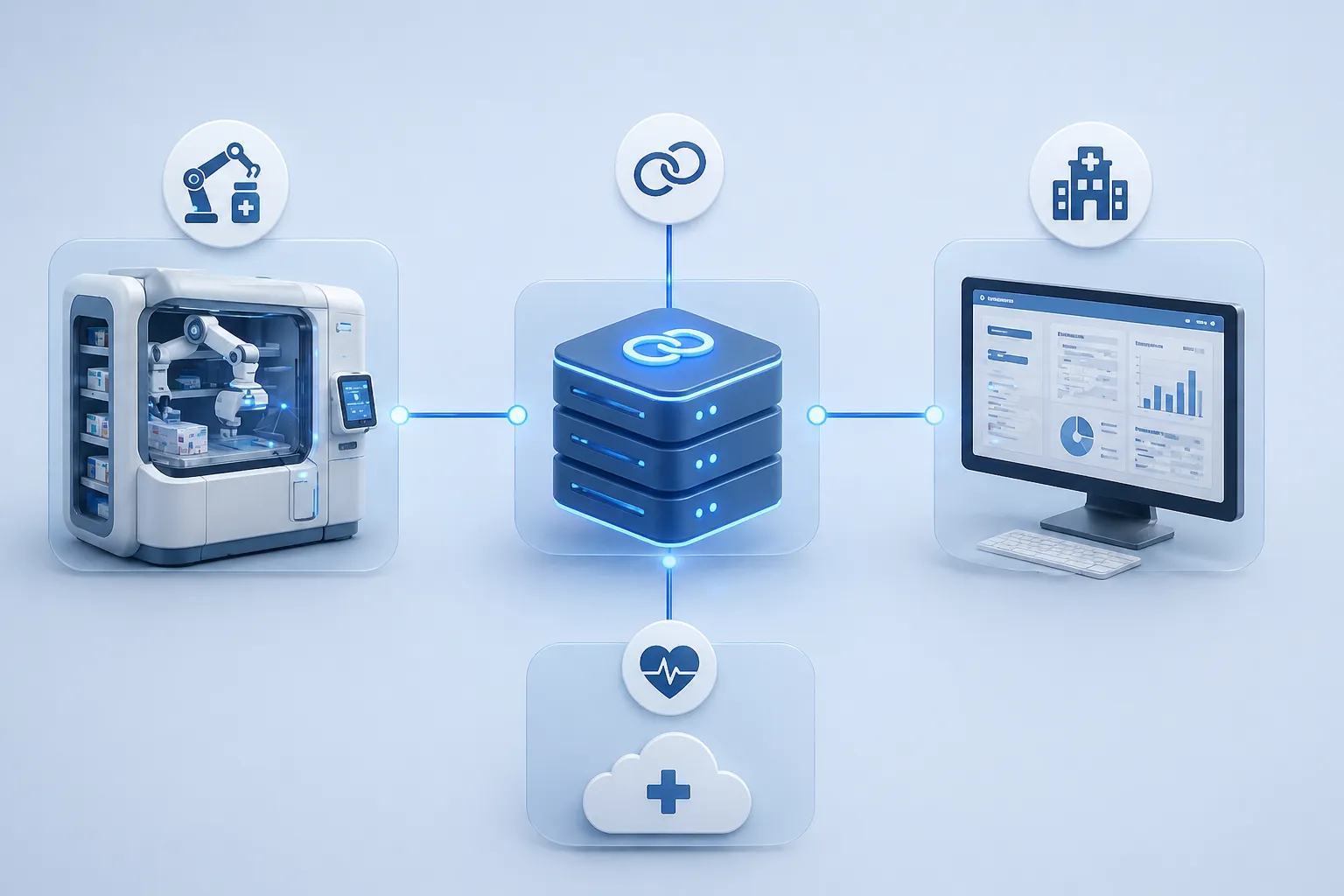 With integration pathways defined, SDH designed a centralized middleware layer to connect the hospital’s critical systems.
The goal was simple in concept but complex in execution: eliminate manual coordination and enable systems to communicate automatically.
The middleware connected:
- The KiroLink pharmacy robot
- The hospital’s ERP system
- The national e-health platform
Instead of relying on staff to transfer information, the middleware managed communication between systems in real time.
Every action triggered the next step automatically.
This architecture became the backbone of the solution.
From Manual Workflow to Automated Lifecycle
Once the integration was live, the medication workflow changed completely.
What had previously required multiple manual actions became a continuous automated process.
Now, the workflow operates as follows:
- A clinician submits a medication order
- The order is transmitted automatically to the pharmacy robot
- The robot retrieves and dispenses the medication
- The ERP system logs the transaction instantly
- The national e-health platform updates records in real time
No manual data transfers.
No duplicate entry.
No reconciliation delays.
Just one connected workflow from start to finish.
Visibility Matters: Real-Time Operational Insight
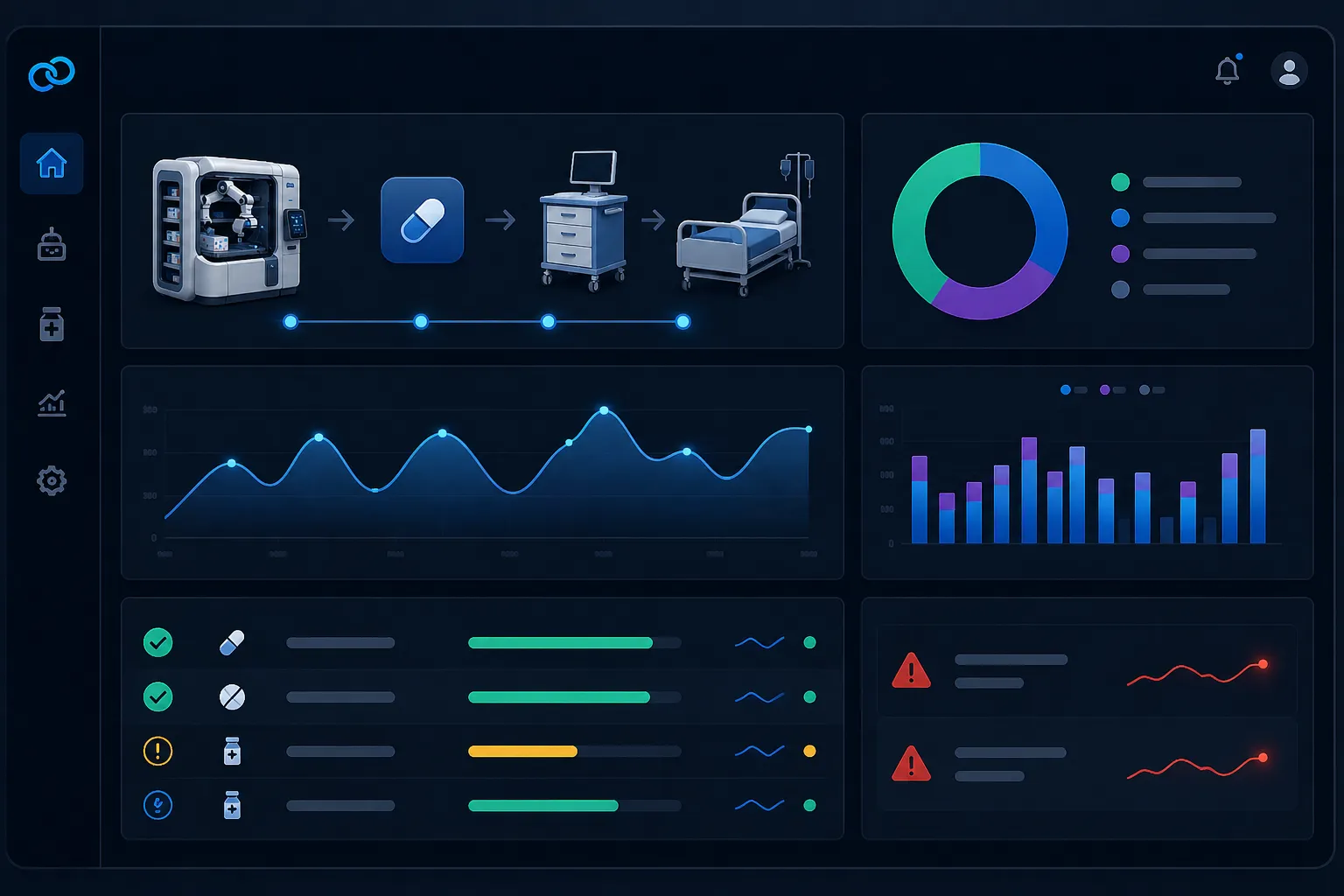 Automation alone improves speed—but visibility improves control.
As part of the implementation, SDH developed a live operational dashboard that provides pharmacy managers with full visibility across the dispensing lifecycle.
This dashboard enables teams to:
- Monitor medication flow
- Track dispensing activity
- Identify workflow bottlenecks
- Maintain operational awareness
Instead of reacting to issues after they occur, teams can respond in real time.
That shift—from reactive to proactive management—has measurable operational value.
Results That Go Beyond Technology
The outcome of the project was not just technical success—it was operational transformation.
By connecting systems that previously functioned independently, SDH enabled the hospital to move from partial automation to full workflow orchestration.
Key outcomes included:
- Three mission-critical systems connected, including a restricted national platform
- Full medication dispensing lifecycle automated, end to end
- Manual reconciliation eliminated
- Operational visibility improved through real-time monitoring
The project required 1,560 engineering hours over 39 weeks, reflecting the depth and complexity of the integration effort.
But the long-term value extended far beyond the initial implementation.
Designed for Growth: From One Hospital to Many
One of the defining decisions in this project was architectural scalability.
Instead of designing a system tailored only to a single hospital, SDH built the middleware to support expansion. The architecture allows additional facilities and new automation technologies to be integrated without rebuilding the core platform.
This capability became critical after the initial deployment.
Following successful adoption, the solution began expanding across public hospitals. The next phase focuses on national replication—bringing the same automated workflow model to additional sites.
Because the integration framework already exists, each new deployment becomes faster and more predictable.
This transforms a one-time project into a scalable national capability.
Why This Case Matters
Healthcare automation is often discussed in terms of devices—robots, systems, platforms.
But this case demonstrates a different reality:
Automation delivers value only when systems work together.
The pharmacy robot was already in place. The ERP system existed. The national platform was operational.
What was missing was orchestration.
By connecting these systems into a unified workflow, SDH transformed isolated technologies into a coordinated healthcare process.
That difference—between tools and systems—is where real efficiency gains happen.
The Broader Impact of Connected Healthcare Systems
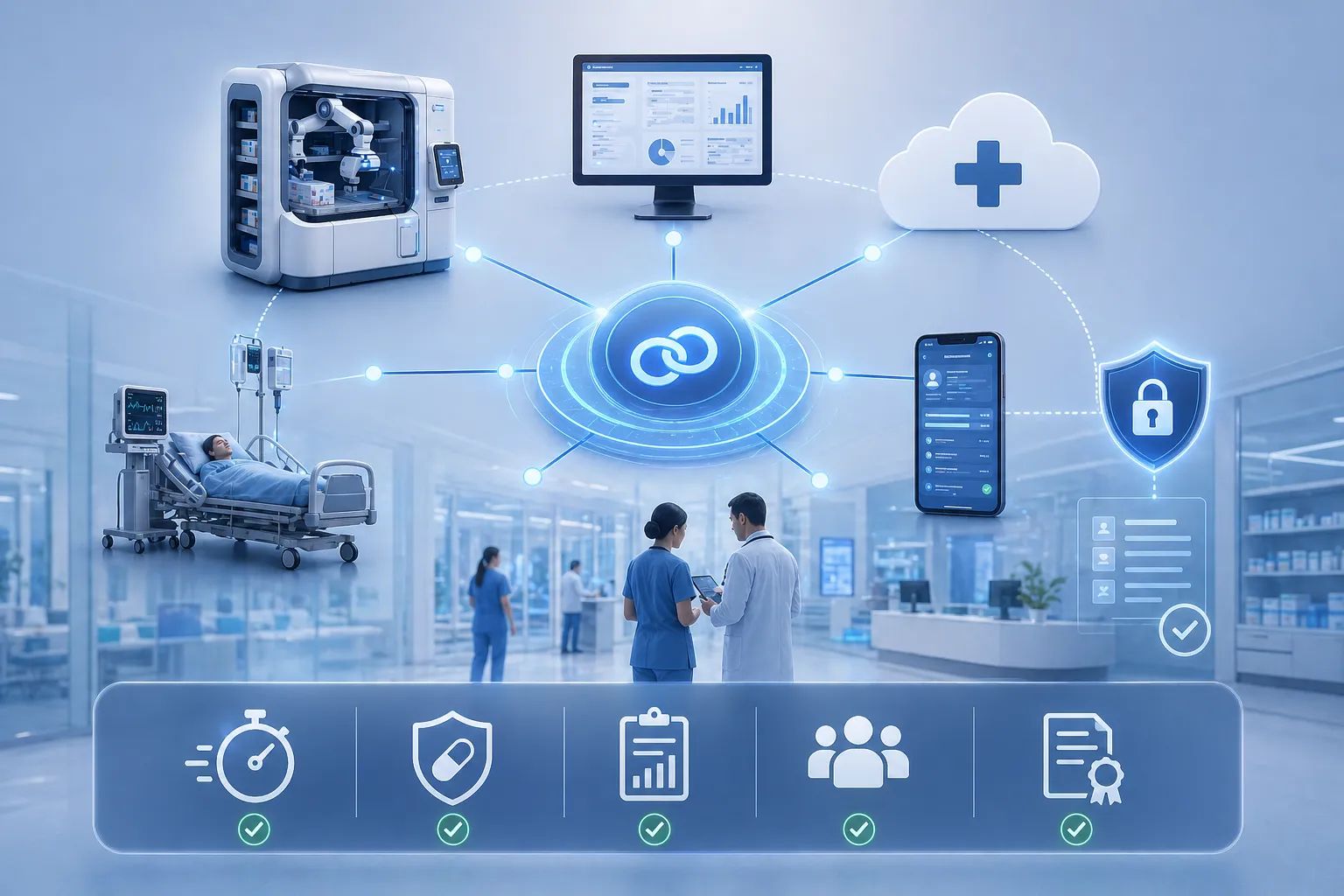 Projects like this highlight a larger shift taking place across healthcare environments.
Hospitals are no longer adopting standalone technologies. They are building integrated ecosystems where data moves seamlessly between systems, devices, and platforms.
This transition supports:
- Faster clinical workflows
- Improved medication safety
- More accurate operational records
- Better resource utilization
- Stronger compliance alignment
And most importantly—it reduces the reliance on manual coordination.
In healthcare environments, every removed manual step reduces risk.
What Comes Next
The success of this integration marks the beginning—not the end—of the transformation.
With the core architecture in place, the system is ready to support:
- Additional hospital deployments
- New pharmacy automation technologies
- Expanded workflow automation
- Broader digital health integration
Because the middleware was built as a flexible foundation, the hospital network can continue evolving without redesigning core infrastructure.
That flexibility is what turns a successful implementation into a sustainable platform.
Built to Connect. Built to Scale.
This project demonstrates what becomes possible when integration is treated as a strategic capability—not just a technical task.
By connecting three critical systems into a single automated workflow, SDH enabled the hospital to eliminate manual handoffs, improve visibility, and create a scalable model ready for national expansion.
One hospital.
Three systems.
Zero manual work.
And a foundation built to grow.
Categories
About the author

Business Analyst at Software Development Hub with extensive experience in business process analysis and B2C&B2B software development. Possesses strong social skills, a creative and strategic mindset, and leadership abilities that contribute to successful team management and project execution.
Share
Recent posts





Need a project estimate?
Drop us a line, and we provide you with a qualified consultation.