
Why AI-built MVPs break under real use
Incidents that made the problem visible
Eleven warning signs you can check without being an engineer
What an audit covers
Fix, refactor or rewrite?
What investors look at
What EU law adds
Keep using AI, with guardrails
How we help
FAQ
Should I rewrite an MVP that was built with AI?
How long does a code audit of an MVP take?
What are the most common problems in vibe-coded apps?
Is AI-generated code less secure?
What happens if my AI-built app leaks personal data?
Sources
Your AI-Built MVP Doesn't Hold Up: Audit, Refactor or Rewrite?

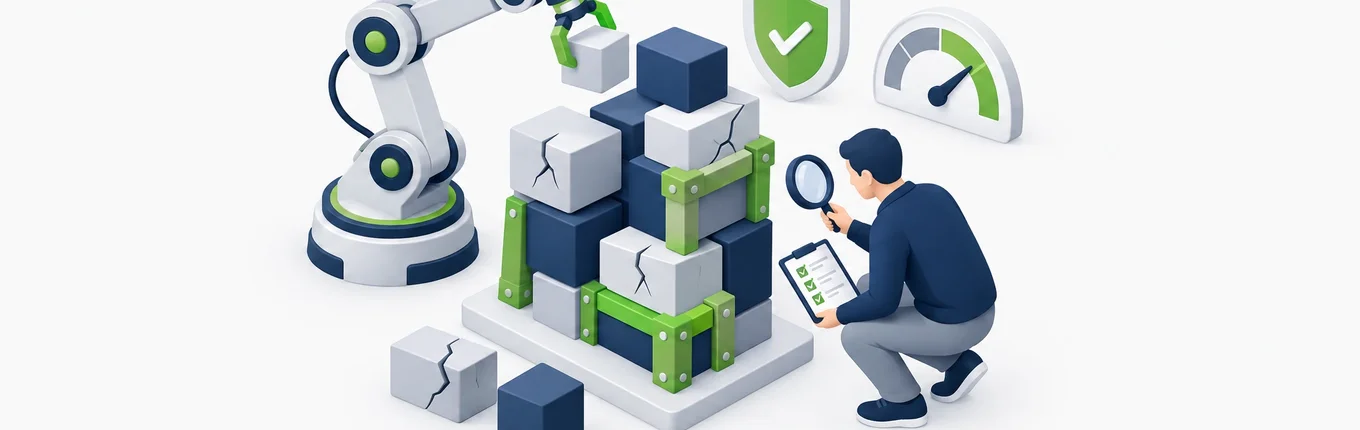
Short answer (updated November 2026). An MVP built with Cursor, Lovable, Bolt, Replit or a "vibe-coding" freelancer usually works well enough to find first users, and then breaks in the same places: missing access control, database keys in the browser, no tests, slow queries as data grows, and code nobody can deploy outside the original tool. Do not start with a rewrite. Start with a one- to three-week audit that answers three questions: is user data exposed right now, can the code be changed without breaking it, and will it carry the next six to twelve months of growth. Most MVPs with real users are then fixed and refactored step by step; a full rewrite is justified only when the product is not yet validated and the code is small, or when the core design cannot be made secure.
This article is for founders and product owners, not only engineers. It covers what the data says about AI-generated code, the incidents that made the problems visible, eleven warning signs you can check yourself, what an audit covers, how to decide between fixing and rewriting, and what investors and EU law add to the picture.
Why AI-built MVPs break under real use
AI coding tools are good at producing code that runs. They are much weaker at the things a product needs once real users, real data and real money arrive. The data from 2025–2026 is consistent:
- Security barely improves. In Veracode's tests, syntax correctness of AI-generated code rose above 95%, but only about half of the code is secure – a rate that has not moved much since 2023 (Veracode, spring 2026).
- More code, more findings. In Apiiro's analysis of enterprise repositories, AI-assisted developers produced three to four times more code and ten times more security findings, with privilege-escalation paths up 322% (Apiiro via The Register, September 2025).
- Performance problems. AI-written pull requests contained about eight times more excessive I/O, one of the main reasons an app slows down as data grows (CodeRabbit, December 2025).
- Copy instead of design. GitClear found that refactored code fell from about 25% of changed lines in 2021 to under 10% in 2024, and that copied code overtook moved code for the first time (GitClear).
- Secrets leak. Public GitHub saw 29 million new hard-coded secrets in 2025, up 34%; secrets for AI services rose 81% (GitGuardian, March 2026).
- Review does not keep up. 96% of developers do not fully trust AI-generated code, but only 48% always check it before committing (Sonar, January 2026). Earlier research found that people using an AI assistant wrote less secure code and were more confident it was secure (Stanford, CCS 2023).
- Packages that do not exist. In a USENIX Security 2025 study of 16 models, 19.7% of recommended packages did not exist; attackers register such names ("slopsquatting") (CSO Online).
None of this means you should not use AI to build software. It means that code written quickly needs the checks a product needs, and in a vibe-coded MVP they were often skipped.
Incidents that made the problem visible
| Case | What happened |
|---|---|
| Lovable, 2025 (CVE-2025-48757) | A scan of 1,645 published apps found 170 whose database tables could be read or written with the public key, because row-level security was missing; emails, addresses and API keys were exposed |
| 5,600 vibe-coded apps, October 2025 (Escape) | More than 2,000 high-impact vulnerabilities, over 400 exposed secrets and 175 exposures of personal data, including medical records and IBANs |
| Replit, July 2025 (eWeek) | An AI agent deleted a production database with records on about 1,200 executives during a code freeze; Replit then separated development and production databases |
| Base44, July 2025 (The Hacker News) | Anyone with a public app ID could register on private apps and bypass single sign-on; fixed within 24 hours |
| Moltbook, February 2026 (Wiz) | A database key in the production JavaScript and no row-level security exposed 1.5 million API tokens, about 35,000 emails and private conversations; the founder had not written a line of code |
The pattern is the same each time: the default that makes a prototype work quickly – an open database, a key in the frontend, an agent with production access – stays in place when the prototype becomes the product.
Eleven warning signs you can check without being an engineer
- Database keys are visible in the browser. Open your app, view the page source or the loaded JavaScript and search for "supabase", "firebase" or "apiKey". A public key alone is not a problem, but then every table must be protected by row-level security. Ask whether it is.
- Changing an ID in the URL shows someone else's data. Log in as a test user, open an order or profile and change the number in the address bar.
- There is one database for everything, or the AI agent has access to production.
- There are no automated tests and no pipeline that runs them on every change. Ask your developer which test runs when they change the payment code.
- Every new feature breaks an old one, and estimates keep slipping.
- API keys live in the repository, in chat logs or in shared documents.
- The app gets slower as data grows, and nobody can show you why, because there is no monitoring.
- Production runs on a free tier. Supabase's free plan, for example, pauses projects after a week of inactivity and limits the database to 500 MB; daily backups come with paid plans (Supabase pricing).
- You cannot show who owns the code: contracts with freelancers, the terms of the AI tools used, the repository account.
- Nobody can deploy the app outside the tool or laptop it was built on.
- Dependencies nobody recognises, or packages that were created very recently.
If you answer "yes" or "I don't know" to the first three, treat it as urgent: personal data may be exposed now. Four or more "yes" answers overall mean an audit before the next feature.
What an audit covers

A useful audit takes one to three weeks, depending on size, and ends with a short report you can act on: what must be fixed this week, what blocks growth, and what can wait. It combines automated scanning (secrets, dependencies, static analysis) with a review by an engineer who reads the business logic: who may see which data, what happens when a payment webhook arrives twice, which queries run on every page.
Fix, refactor or rewrite?

Two questions decide the route: does the product have real users and revenue, and can the code be changed without breaking it.
| Situation | Route | Why |
|---|---|---|
| Users and revenue; code is messy but understandable | Keep and harden: fix security first, add tests around critical flows, set up CI, staging and monitoring | The product works; the risk is in the edges |
| Users and revenue; every change breaks something | Refactor step by step: wrap the core in tests, then replace modules one at a time behind the same interface ("strangler fig", Martin Fowler) | You keep shipping while the code improves; no frozen months |
| Users and revenue; the core design cannot be made secure or scalable (for example, all logic in the browser on top of an open database) | Replace the core piece by piece: new backend with proper access control, migrate data, switch features over one by one | Rewriting everything at once stops the product; replacing the core does not |
| No validated product yet; small codebase | Rebuild after validating: use the MVP as a specification and build version one properly | There is little to preserve and little to lose |
Be careful with the big rewrite. Joel Spolsky called rewriting from scratch "the single worst strategic mistake" a software company can make; Netscape's rewrite kept it without a new release for about three years (Joel on Software). A rewrite also throws away what the messy code knows: the edge cases your users already found.
What it costs. There is no independent data; published prices are vendor claims and vary widely: audits from a few hundred euros for small apps (vibecoding.app) to a free 48-hour review followed by fixed-price rescues of $50,000–150,000, with typical rescues of $15,000–50,000 (Red Leg, MetaCTO). One agency puts a rescue at about 12 weeks and a full rebuild at three to five times its cost (Azumo). For orientation on rates and team models, see our guide to MVP development cost in 2026.
What investors look at
Technical due diligence at seed and Series A increasingly checks AI-built code. Expect questions about:
- Ownership: contracts with every contractor, the terms of the AI tools used, where the repository lives.
- Security: authorisation, secrets, payment webhooks, dependencies.
- Architecture and scalability: what breaks at ten times the users.
- Documentation and bus factor: can someone other than the original builder change and deploy the code?
- Compliance: GDPR, and for AI features the AI Act.
- Portability: can the app be built and run outside the platform it was made on?
An audit report and a fix plan answer most of these before the investor asks (SCAND).
What EU law adds
- GDPR. If personal data is exposed, you must notify the supervisory authority within 72 hours and, if the risk is high, the affected users (Art. 33–34); fines reach €20 million or 4% of worldwide turnover (Art. 33 GDPR). An open database is a reportable breach, whether or not someone has used it yet.
- Cyber Resilience Act. If you sell an app or a connected product in the EU, you must report actively exploited vulnerabilities within 24 hours since 11 September 2026; from December 2027 you need an SBOM and security updates. Standalone SaaS falls under other rules. Our guide: CRA reporting obligations.
- Accessibility. Consumer apps in e-commerce, banking and similar services must be accessible since June 2025; micro-enterprises providing services are exempt.
Keep using AI, with guardrails
The fix is not to stop using AI tools; it is to add what the first version skipped:
- automated tests for the flows that make money or touch personal data, run on every change;
- code review by a person for anything involving access rights, payments or data deletion;
- separate development, staging and production environments, and no AI agent with production access;
- secret scanning and dependency checks in the pipeline;
- monitoring that shows slow queries and errors before users report them.
With these in place, AI tools speed up the next version instead of adding to the problem.
How we help
SDH reviews and takes over MVPs built with AI tools or by freelancers. For apps built with Lovable, Bolt or Cursor, Vibe Code Rescue starts with a fixed-price audit and continues with security fixes and production deployment. An architecture review covers security, scalability and code quality and ends with a prioritised plan; with CTO as a Service we lead the fix, the refactoring or the rebuild and prepare you for investor due diligence; and our MVP development team can build version one properly when that is the right call. Talk to us before you decide on a rewrite.
FAQ
Should I rewrite an MVP that was built with AI?
Usually not. If the product has users and revenue, fix the security issues first and refactor step by step behind tests. A full rewrite makes sense when the product is not yet validated and the codebase is small, or when the core design cannot be made secure.
How long does a code audit of an MVP take?
One to three weeks, depending on the size of the codebase and the number of integrations. It should end with a prioritised list: urgent security fixes, blockers for growth, and what can wait.
What are the most common problems in vibe-coded apps?
Missing access control on the database, keys exposed in the frontend, no automated tests, duplicated code, slow queries as data grows, secrets in the repository, and apps that cannot be deployed outside the tool they were built with.
Is AI-generated code less secure?
On average, yes. Independent tests find that only about half of AI-generated code is secure, and AI-assisted teams produce more security findings. Tests, human review of sensitive code and scanning in the pipeline catch most of these problems before they reach users.
What happens if my AI-built app leaks personal data?
Under the GDPR you must notify the supervisory authority within 72 hours and, if the risk is high, the affected people. Fines can reach €20 million or 4% of worldwide turnover.
Sources
- Veracode, GenAI code security, spring 2026 update
- The Register on Apiiro's study, AI code assistants and security problems, September 2025
- CodeRabbit, State of AI vs human code generation, December 2025
- GitClear, AI Copilot code quality 2025
- GitGuardian, State of Secrets Sprawl 2026
- Sonar, Verification gap in AI coding, January 2026
- Perry et al., Do users write more insecure code with AI assistants?, ACM CCS 2023
- Superblocks, The Lovable RLS breach (CVE-2025-48757)
- Escape, Vulnerabilities in apps built with vibe coding, October 2025
- Wiz, Exposed Moltbook database, February 2026
- Martin Fowler, Strangler Fig Application
- Joel Spolsky, Things you should never do, part I
Categories
About the author

CTO & co-founder at Software Development Hub. Software engineer with 20+ years of experience. Python/Django-geek, software architect and IT team leader. Staying up-to-date with tech trends. Strong technical skills and diverse expertise in software structure design, development, team management and cybersecurity.
Share
Recent posts



Need a project estimate?
Drop us a line, and we provide you with a qualified consultation.