
The market in 2026: fewer shortages, flat prices
Three engagement models, and when each fits
What it costs
The checklist: 12 questions before you sign
Usage rights: name them, or you may not have them
A dedicated team is not your staff
Data protection and security obligations
How we work
FAQ
What does software development cost in Germany in 2026?
Fixed price or time and material: which is better?
Is a fixed-price software contract a Werkvertrag?
Can we work with a dedicated team without labour leasing?
Do we own the code a contractor writes?
Do we need a data processing agreement with a software contractor?
Sources
How to Choose a Software Development Contractor in Germany in 2026: A 12-Point Checklist and Engagement Models With Prices

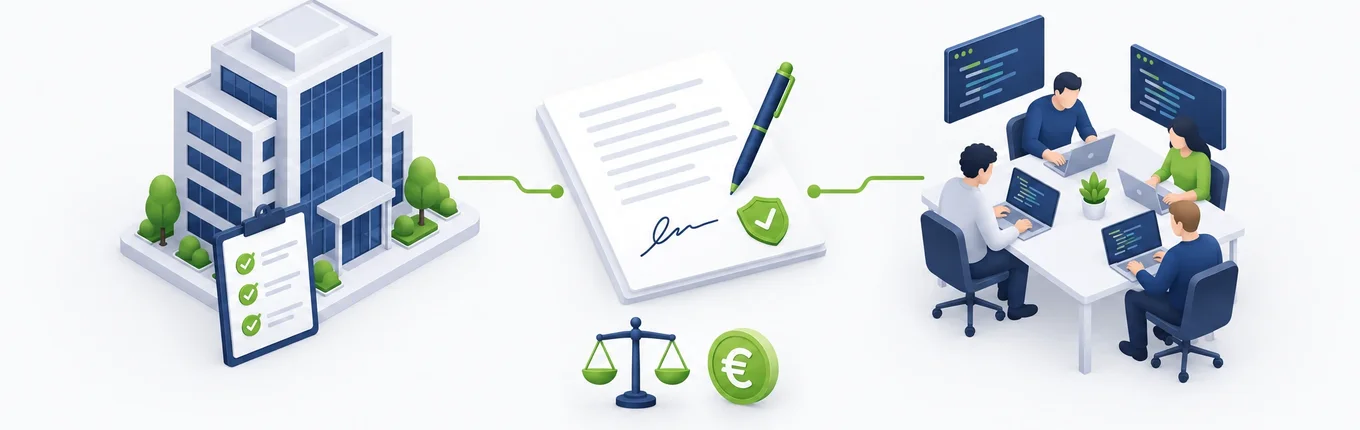
Short answer (November 2026). Germany is still short of 79,000 IT specialists, according to Bitkom, so most companies that need software built will buy at least part of it. Freelance IT specialists in Germany charge a median of €95 an hour (€90 for software and web development, €120 for SAP), and European IT service providers bill developers at €805 to €1,498 a day, depending on seniority. The price per hour matters less than the contract: a fixed price is usually a Werkvertrag with formal acceptance (Abnahme) and the risk of overrun on the contractor, while time and material is usually a Dienstvertrag where you pay for effort. A dedicated team that your own managers direct like employees risks being treated as illegal labour leasing under the AÜG. Before you sign, check references you can call, who actually writes the code, the transfer of usage rights, the data processing agreement, security obligations under NIS2, and how you get out.
This guide is for German companies and founders choosing an external development partner: what the market looks like in 2026, which engagement model fits which stage, what each costs, and a checklist of twelve questions to ask before you sign.
The market in 2026: fewer shortages, flat prices
The pressure has eased but not gone. Bitkom counted 79,000 unfilled IT positions in its September 2026 survey, down from 149,000 in 2023 and 109,000 in 2025, yet 97% of companies still report difficulties filling IT roles and 76% expect the shortage to worsen again.
Prices have stopped rising. In the Freelancer-Kompass 2026, the average rate across all freelancers fell for the first time, from €104 to €103 an hour, and 56% of IT freelancers reported fewer orders than a year earlier. Day rates of IT service providers fell too: Metrics data published by CIO.de shows specialists 4.6% cheaper than in 2025. And the work is moving: in a Lünendonk survey, 47% of IT service providers consider it likely that by 2030 more than half of IT services for Germany will be delivered from nearshore and offshore locations.
For a buyer, that means more choice and more negotiating room than two years ago, and more reason to check what is behind an offer.
Three engagement models, and when each fits

| Fixed price | Time & Material | Dedicated team | |
|---|---|---|---|
| You buy | a defined result | hours of work | the capacity of named people |
| Usual German contract type | Werkvertrag, § 631 BGB | Dienstvertrag, § 611 BGB | Dienstvertrag |
| Acceptance | formal Abnahme, § 640 BGB | none; you review continuously | none; you review continuously |
| Who carries overrun | the contractor, within the agreed scope | you | you |
| Change of scope | change request, priced | reprioritise the backlog | reprioritise the backlog |
| Fits when | scope and acceptance criteria are written down | scope is still moving | the product runs for years |
| Watch out for | a price for a guess, change-request disputes | no budget ceiling | being treated as labour leasing |
Most projects do not need one model for their whole life. A common and sensible path: a short paid discovery on time and material to clarify scope and risks, a fixed price per milestone for the first release, and a dedicated team or time and material for the product's evolution. A fixed price agreed without discovery is a price for a guess; either the contractor has added a large risk premium, or the change requests will start in week three.
Whichever model you choose, the overrun risk is real. McKinsey's study of more than 5,400 IT projects found that large ones ran 45% over budget and 7% over time while delivering 56% less value than predicted. The contract decides who pays for that.
What it costs

- Freelancers in Germany: a median of €95 an hour for IT, €90 for software and web development, €120 for SAP and ERP (Freelancer-Kompass 2026, 5,412 respondents). The rate covers one person; project management, testing and a replacement if they leave are your problem.
- IT service providers in Europe: €805 a day for a developer with three or more years of experience, €1,192 for a senior, €1,498 for a specialist (European averages from Metrics benchmarks of signed contracts, published by CIO.de in March 2026).
- Nearshore teams: there is no neutral public benchmark. A 2026 price guide by a Polish vendor puts senior developers in Poland, Romania, Portugal and Ukraine at roughly half of German rates; treat such tables as marketing until a quote confirms them.
- SDH: €40 to €55 an hour, under a German contract with SDH IT GmbH, with a paid discovery and clickable prototype for up to €1,000 in one to two weeks.
The hourly rate is only one factor. Compare the price of a defined result: the same scope estimated by each shortlisted contractor, with the assumptions written down. Our project estimate calculator and the MVP cost guide give a first range.
The checklist: 12 questions before you sign
| # | Check | Ask for | Red flag |
|---|---|---|---|
| 1 | Comparable references | two clients with a similar project you can call | only logos, no names you may contact |
| 2 | Who writes the code | the share of own staff, freelancers and subcontractors | "our network of partners", no names |
| 3 | Discovery before a fixed price | a short paid phase with a written result | a fixed price after one call |
| 4 | The contract type fits the model | Werkvertrag with acceptance criteria, or Dienstvertrag with reporting | "fixed price" in a contract that describes hours |
| 5 | Usage rights | an explicit, exclusive, unlimited grant including source code and the right to modify | "you may use the software" |
| 6 | Personal data | a data processing agreement (Art. 28 GDPR), list of sub-processors, SCCs for access from outside the EU | "we do not need an AVV, we only write code" while working on your production data |
| 7 | Security | ISO 27001 or TISAX where your industry needs it, and how they handle your access, secrets and incidents | shared accounts, credentials in chat |
| 8 | Team stability | named key people, a replacement period, knowledge transfer when someone leaves | a team assembled after you sign |
| 9 | Transparency from day one | access to the repository, task tracker and builds, in your accounts or with your admin rights | code shown only at demos |
| 10 | Change control and reporting | how scope changes are priced and approved, a weekly demo and budget report | changes agreed in calls, invoiced later |
| 11 | Exit | handover of code, documentation and infrastructure, a notice period, no proprietary lock-in | your product depends on the contractor's private libraries or accounts |
| 12 | Who directs the team | tasks go through the contractor's lead, not your line managers | the contractor's developers in your org chart |
Two items need a closer look, because German law makes them expensive to get wrong.
Usage rights: name them, or you may not have them
Under § 69b UrhG, an employer automatically receives the economic rights to software its employees write. That rule does not cover external contractors. Copyright itself cannot be transferred in Germany; the contractor grants you usage rights under § 31 UrhG, and under the purpose-of-transfer rule in § 31(5), rights that are not listed are granted only as far as the purpose of the contract requires. The contract should therefore list them: exclusive, unlimited in time and territory, including the source code, the right to modify, to sublicense and to have others develop the software further. Ask separately about open-source components and their licences.
A dedicated team is not your staff
A dedicated team is legal and common. It becomes a problem when the contractor's developers are integrated into your organisation and take instructions from your managers. Under § 1 AÜG that is labour leasing, which needs a licence, has to be named as such in the contract, and requires the leased workers to be named in advance. If those conditions are missing, § 10 AÜG deems an employment relationship between you and the workers, and fines reach up to €30,000. For individual freelancers the corresponding risk is bogus self-employment (Scheinselbstständigkeit), which the Deutsche Rentenversicherung can assess in a status procedure under § 7a SGB IV. A draft law to simplify that assessment was published in March 2026, with a planned start in 2028; it is not yet in force.
The practical rule: you set goals and priorities, the contractor's lead assigns the work, and the people stay in the contractor's organisation. This is not legal advice; have the contract reviewed by a lawyer.
Data protection and security obligations
- Data processing agreement. As soon as the contractor can see personal data, in a production database, logs, support tickets or test data copied from production, Art. 28 GDPR requires a contract that binds them as a processor, with prior approval of sub-processors.
- Access from outside the EU. For countries without an EU adequacy decision, such as Ukraine, the standard contractual clauses (Commission Decision 2021/914, module 2 for controller to processor) and a transfer impact assessment are the usual basis. Ask where each person with access works.
- NIS2. Germany's NIS2 implementation act has been in force since 6 December 2025 and covers about 29,500 entities, up from about 4,500. If your company is one of them, § 30 BSIG requires you to manage the security of your supply chain, including your direct suppliers and service providers. Your software contractor is part of it.
- Cyber Resilience Act. If you sell software or connected products, the CRA's reporting obligations for exploited vulnerabilities have applied since 11 September 2026, and the main requirements apply from 11 December 2027. Your contractor's processes for vulnerabilities and updates become yours; see our guide to the CRA reporting duty and the compliance calendar 2026–2028.
- Certifications. ISO/IEC 27001 certifies an information security management system; certificates under the 2013 version expired on 31 October 2025, so ask for a 2022 certificate. Automotive suppliers are usually asked for TISAX, whose new catalogue ISA 2027 applies from 1 January 2027. A certificate is evidence, not a substitute for asking how access, secrets and incidents are handled on your project.
How we work
SDH IT GmbH is based in Hamburg and is a member of Bitkom. Clients sign a German contract with us; the engineering team is distributed and consists of our own staff, without freelancers or subcontractors. We work on time and material, fixed price and flexible scope, and with dedicated teams, and many projects use the path described above: discovery, a fixed-price first release, then a team. Our legal documents, from the master service agreement and statement of work to the NDA, SLA and IP terms, are public, and a data processing agreement is part of every project with personal data. The engagement models page describes the options in detail.
FAQ
What does software development cost in Germany in 2026?
Freelance IT specialists charge a median of €95 an hour, €90 for software and web development and €120 for SAP. European IT service providers bill €805 a day for a developer and up to €1,498 for a specialist. Nearshore teams cost less, but there is no neutral benchmark; compare quotes for the same written scope.
Fixed price or time and material: which is better?
Fixed price fits when scope and acceptance criteria are written down; the contractor then carries the risk of overrun within that scope. Time and material fits when scope is still moving; you pay for effort and keep control of priorities. Many projects combine both: discovery on time and material, the first release at a fixed price, then a team.
Is a fixed-price software contract a Werkvertrag?
Usually, yes: the contractor owes a result, which you formally accept (Abnahme, § 640 BGB). Time and material is usually a Dienstvertrag, where the contractor owes the work, not a result. The wording of the contract decides, not its title.
Can we work with a dedicated team without labour leasing?
Yes, if the people stay in the contractor's organisation and receive their tasks from the contractor's lead. If your managers direct them like employees and they are integrated into your organisation, it can count as labour leasing under the AÜG, with serious consequences.
Do we own the code a contractor writes?
Only to the extent the contract grants you usage rights. Under German law, rights that are not listed are granted only as far as the purpose of the contract requires, so the contract should name exclusive, unlimited rights including the source code and the right to modify it.
Do we need a data processing agreement with a software contractor?
Yes, as soon as the contractor can access personal data, for example in a production database, logs or support tickets. For access from countries without an EU adequacy decision, standard contractual clauses are also needed.
Sources
- Bitkom, IT-Fachkräftemangel hat sich in den letzten drei Jahren halbiert, September 2026
- freelancermap, Freelancer-Kompass 2026: press release, July 2026
- CIO.de, IT-Berater-Tagessätze 2026: Das Ende der Preisrallye, March 2026
- Lünendonk, Der Markt für IT-Dienstleistungen in Deutschland 2025
- McKinsey Digital, Delivering large-scale IT projects on time, on budget, and on value, 2012
- German Civil Code, § 611, § 631, § 640 BGB
- Copyright Act, § 31 and § 69b UrhG
- Temporary Employment Act, § 1 and § 10 AÜG; Social Code IV, § 7a SGB IV
- GDPR, Article 28; European Commission, Standard contractual clauses (2021/914) and adequacy decisions
- BSI, NIS-2-Umsetzungsgesetz in Kraft, December 2025; § 30 BSIG
- European Commission, Cyber Resilience Act
- ENX, ISA 2027, July 2026
Categories
About the author

CEO & Co-Founder at Software Development Hub. Innovation-driven expert with 20+ years of experience. A business practitioner with experience in creating and launching startups, an innovator and progressive-minded specialist, who helps turn raw ideas into profitable results.
Share
Recent posts


Need a project estimate?
Drop us a line, and we provide you with a qualified consultation.