
Why exceptions became the main workload
What an agent adds to a control tower
An exception playbook
How much autonomy, and when
Data quality comes before the agent
European and German obligations to plan for
What we have built
A checklist for the first agent
How we can help
FAQ
What is a logistics control tower?
What can an AI agent do in a control tower?
Will AI agents replace logistics planners?
Which exceptions should an agent handle first?
Who is liable if an agent makes a wrong decision?
Does the EU AI Act apply to logistics agents?
Sources
AI Agents in a Logistics Control Tower: Handling Shipment Exceptions Automatically

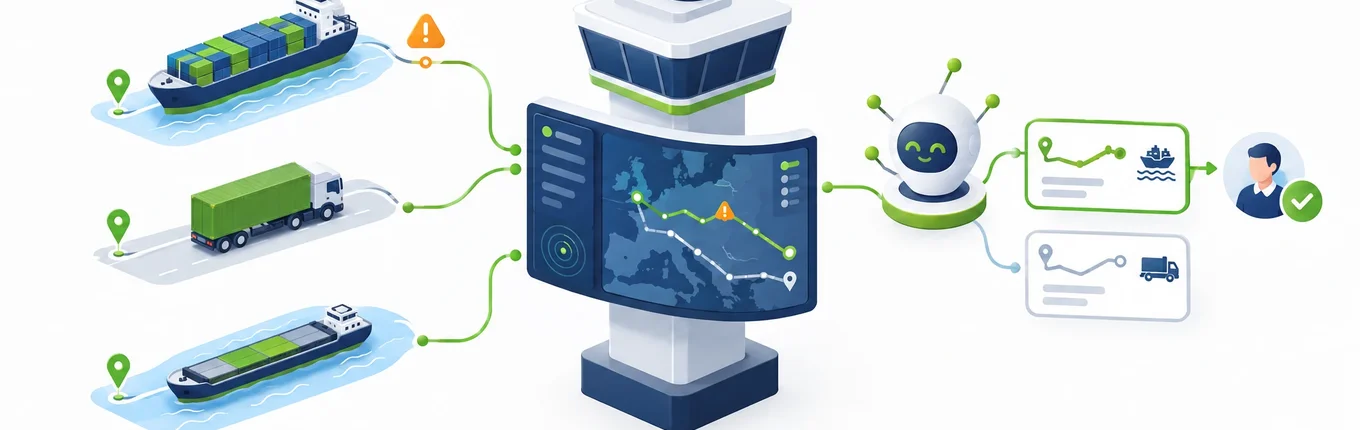
Short answer (November 2026). A control tower shows that a shipment is late; an AI agent can find out why, work out the options and prepare the fix. Gartner expects 60% of supply chain disruptions to be resolved without human intervention by 2031, and the need is obvious: global container schedule reliability fell to 49.9% in August 2026, the lowest since September 2022. The safe design for 2026 splits the work three ways. Code detects exceptions from live events and checks facts. The agent investigates and proposes: rebook, split, change mode, tell the customer. A person approves anything that costs money or changes a promise. Under German law a carrier's liability for late delivery is capped at three times the freight, so paying for an expedited alternative is a commercial decision, not an IT one. Start with one or two frequent exception types, let the agent propose, and raise its autonomy only where the log shows that people approve its proposals unchanged.
This article is for logistics and supply chain leaders who already have, or are building, a control tower and want to know what agents can realistically take over. It continues our earlier article on the logistics challenges control towers solve.
Why exceptions became the main workload
The disruptions of 2026 are not a single crisis but a steady stream:
- Ocean. Sea-Intelligence measured global schedule reliability at 49.9% in August 2026, down 5.9 points in a month; late vessels arrived 6.81 days late on average, the most since March 2022. Red Sea routing was only 27% back to normal in September, as carriers moved some services back to Suez step by step.
- Inland waterways. On 1 October 2026 the Rhine gauge at Kaub fell to minus six centimetres, a new historic low. A 4,600-tonne load from Rotterdam to Nuremberg needed 14 barges instead of three.
- Data. In a study of more than 500,000 ocean shipments by the platform Tradlinx, carriers left the ETA blank in 8.43% of cases, and 5% of ETAs missed by 48 hours or more. Every planner who has chased a container knows the result: exceptions are found late, and investigating each one means e-mails, portals and phone calls.
A dashboard turns this into red lights. Someone still has to find out what happened, what it affects and what to do. That investigation is where agents help.
What an agent adds to a control tower

- Detect, in code. Rules on live events decide what counts as an exception: an ETA that moved beyond a threshold, a pickup without a scan, a customs status that stopped, a document that contradicts the order. Detection must be deterministic, cheap and explainable; it is not a job for a language model.
- Investigate, by the agent. This is the expensive human work today. The agent reads the tracking history, the carrier's e-mails, the order and its documents, the customer's priority and the SLA, and writes down what happened and what it affects.
- Propose, by the agent. Options with their cost and impact: wait, rebook on the next sailing, split the shipment, switch mode, inform the customer with a new date. Each proposal states its assumptions.
- Approve, by a person. Anything that costs money or changes what was promised to a customer.
- Execute, through tools. The agent books through the TMS or a carrier API, sends the customer message and updates the portal. These are tools with narrow rights, ideally behind an MCP server or an API layer that checks every call.
- Record. What happened, what was decided, by whom and why. Exceptions that recur with the same decision become new rules.
The vendors already describe the same split. C.H. Robinson reported in January 2026 that its teams had spent over half the day chasing missed less-than-truckload pickups; now one AI agent contacts carriers and another decides the next steps, and the company says 95% of these checks are automated. project44 launched an exceptions management agent in April 2026 and describes its agents as human-controlled, with intervention points at every critical step; early customers reported 17% less manual exception handling. These are vendor figures, but the architecture they describe is the one above.
An exception playbook
| Exception | Detected by code | The agent investigates | The agent proposes | Who decides |
|---|---|---|---|---|
| Ocean ETA moves by days | carrier ETA against plan, beyond threshold | vessel schedule, transshipment, the customer's delivery date | wait, rebook, partial airfreight; a new date for the customer | planner; customer message after approval |
| Missed pickup | no pickup scan by the end of the window | carrier status, driver contact, warehouse readiness | a new slot, another carrier | dispatcher for another carrier; a new slot with the same carrier within policy |
| Customs hold | status unchanged, a request from the authority | which document or data is missing, for example in the ICS2 entry summary | the corrected data and a draft reply to the broker | customs specialist |
| Document mismatch | weight, value or HS code differ between order, invoice and packing list | which source is right, what the customer wrote | a correction request to the customer | the agent may ask; a person changes the order |
| Barge capacity at low water | water level forecast below the loading threshold | affected bookings, rail and road alternatives | split loads, a modal shift, a revised cost | logistics manager |
| "Where is my shipment?" | an incoming customer message | the current status and the latest ETA | an answer with the status and the next step | the agent answers within policy |
Two rules make this table work. First, facts are checked by code, not by the model: in our own freight intake agent, the weight stated by the customer, the weight on the invoice and the weight on the packing list are compared by a validator, and so are the declared value against the invoice total and the format of the HS code. The model extracts the values; code decides whether they conflict, and a person sees the conflict with both sources. Second, the agent never changes a promise on its own: a new delivery date to a customer, an extra cost, a cancelled booking.
The German Commercial Code explains why the second rule is not bureaucracy. Under § 425 HGB a carrier is liable for loss, damage and late delivery, but § 431 HGB caps liability for exceeding the delivery time at three times the freight. Whether to pay for airfreight to protect a customer relationship is therefore a commercial judgement, often worth far more than the carrier would ever owe. An agent can calculate it; a person should decide it.
How much autonomy, and when

Autonomy is set per exception type, not for the agent as a whole. A sensible path:
- Level 1, summarise, is safe from the first day: the agent writes what happened and what it affects. Planners stop opening five systems.
- Level 2, propose, is the right default for 2026: the agent drafts the rebooking and the customer message, a person approves or edits with one click.
- Level 3, act within policy, is earned. When the log shows that planners approve the agent's proposals for an exception type almost unchanged for several weeks, reversible and cheap steps for that type can run automatically and be reported: an updated ETA in the portal, a status message, a new pickup slot with the same carrier.
- Level 4, spending money or changing promises without asking, is where the risk is greatest. Gartner also expects more than 40% of agentic AI projects to be cancelled by the end of 2027 because of costs, unclear value or weak risk controls.
The approval log is the most valuable data the project produces: it shows which exception types the agent handles well, which proposals people change and why, and where the rules are missing.
Data quality comes before the agent
An agent working on bad data automates bad decisions faster. The Tradlinx figures above, an empty ETA in more than 8% of shipments and a mean miss of 15.4 hours, are the normal state of ocean data, not an outlier. Before an agent proposes anything, the control tower needs:
- Event sources it can trust, with the age of each data point visible. The agent should say "the last carrier update is 30 hours old" rather than present an old ETA as current.
- Clean master data: customers, locations, carriers and service levels with consistent identifiers across WMS, TMS and ERP. Our own control tower synchronises these systems on a schedule for exactly this reason.
- A defined priority per order or customer, because "which shipment matters most" is the question every proposal depends on.
Gartner expects that by 2028, 40% of supply chains will address AI-ready data quality issues with AI-enabled data management tools. That is a useful first project for the same agent: finding contradictions in master data before anyone acts on them.
European and German obligations to plan for
- eFTI. Regulation (EU) 2020/1056 applies in full from 9 July 2027: authorities in every Member State must then accept freight transport information shared electronically through certified eFTI platforms. Some may start earlier. For a control tower that already holds the data, this is a chance to send it once instead of printing it.
- ICS2. Since 1 September 2025, road and rail operators bringing goods into the EU must file safety and security data in the import control system ICS2; Germany had no derogation. Incomplete entry summaries are a typical customs exception an agent can investigate.
- e-CMR. Germany acceded to the protocol on the electronic consignment note in January 2022. Electronic transport documents make document exceptions machine-readable instead of hidden in scans.
- EU customs reform. The provisional agreement of March 2026 on the Union Customs Code reform foresees an EU customs data hub replacing more than 100 national systems over the coming years. Data interfaces built now should expect it.
- AI Act. Exception handling in logistics is generally not a high-risk use under the AI Act. If the agent writes to customers or drivers directly, Article 50 has applied since 2 August 2026: people must be told they are interacting with an AI system.
What we have built
- Control Tower: our solution that consolidates data from WMS, TMS and ERP systems such as SAP and Oracle into one operational view, with on-time delivery and stock movement metrics and automatic highlighting of exceptions. It is the detection layer an agent needs.
- AI Intake Agent: in its freight forwarding configuration, the agent takes a transport request from free text and PDF documents, keeps a checklist of what is still missing, has code check weight, value and HS code across documents, and hands a complete request to a forwarder for approval, over e-mail, messengers or a website chat.
- Maritime logistics software: fleet and cargo tracking with ETA prediction and route optimisation for a shipping company.
What these projects have taught us is reflected in the rules above: checks in code, proposals by the agent, decisions by people, and a log of everything.
A checklist for the first agent
- Pick one or two exception types with enough volume and a clear owner, for example missed pickups or ocean ETA changes.
- Write the detection rules in code, with thresholds the operations team agrees with.
- List the sources the agent may read and the tools it may use, each with narrow rights.
- Define what needs approval: every cost, every change of a customer promise, every cancellation.
- Show the age of every data point in the agent's summary.
- Start at level 1 or 2; log every proposal, the decision and the edit.
- Review the log weekly; raise autonomy per exception type only on evidence.
- Tell customers and drivers when they are talking to an AI.
- Measure what matters: time from detection to decision, share of proposals approved unchanged, customer messages sent on time.
How we can help
We build agentic AI applications for logistics on top of existing WMS, TMS and ERP systems, and our Control Tower provides the detection layer and the integrations. A first exception type with an agent at the proposal level is a realistic first project; we start with the data and the approval rules, not with the model.
FAQ
What is a logistics control tower?
A combination of people, processes, data and technology that captures near real-time operational data across the supply chain to give visibility and support decisions, in Gartner's definition. In practice: one view of shipments, inventory and exceptions across WMS, TMS, ERP and carrier data.
What can an AI agent do in a control tower?
Investigate exceptions the control tower detects, by reading tracking data, e-mails, documents and orders; summarise what happened and what it affects; propose options with costs; and, after approval, execute them through the TMS, carrier APIs and customer messages.
Will AI agents replace logistics planners?
Not in 2026. They take over the investigation and the routine steps; people decide what costs money or changes a customer promise. Gartner expects 60% of supply chain disruptions to be resolved without human intervention by 2031, which still leaves the hard 40% to people.
Which exceptions should an agent handle first?
Frequent, well-defined ones with a clear owner and reversible fixes: missed pickups, ocean ETA changes, status questions from customers. Avoid starting with exceptions where every case is a negotiation.
Who is liable if an agent makes a wrong decision?
The company that runs it. That is why consequential actions need a person's approval, and why every proposal, decision and execution must be logged.
Does the EU AI Act apply to logistics agents?
Exception handling in logistics is generally not a high-risk use. If the agent communicates with customers or drivers, the transparency duty of Article 50 applies since 2 August 2026: people must be told they are talking to an AI.
Sources
- Gartner, Gartner Supply Chain Symposium/Xpo Barcelona: Day 1 highlights, May 2026
- Gartner, Half of supply chain management solutions will include agentic AI capabilities by 2030, May 2025
- Gartner, Over 40% of agentic AI projects will be canceled by end of 2027, June 2025
- Gartner via CDOTrends, What is a supply chain control tower, 2022
- Sea-Intelligence, Global schedule reliability continues to plummet in August, September 2026, and Red Sea crisis is 27% normalized, September 2026
- transport-online.de, Rhein auf Rekordtief, October 2026
- DC Velocity, Study: ocean carrier ETAs are often inaccurate or missing completely, October 2026
- C.H. Robinson, AI agents for LTL pickup efficiency, January 2026
- FreightWaves, project44 unveils fleet of AI agents, April 2026
- German Commercial Code, § 425 and § 431 HGB
- European Commission, eFTI Regulation
- FIATA, ICS2 Release 3 goes live on 1 September 2025
- United Nations Treaty Collection, Additional Protocol to the CMR concerning the electronic consignment note
- European Parliament, Deal reached on Union Customs Code reform, March 2026
- EU AI Act, Article 50
Categories
About the author

CEO & Co-Founder at Software Development Hub. Innovation-driven expert with 20+ years of experience. A business practitioner with experience in creating and launching startups, an innovator and progressive-minded specialist, who helps turn raw ideas into profitable results.
Share
Recent posts




Need a project estimate?
Drop us a line, and we provide you with a qualified consultation.