
What Is On-Premise Infrastructure?
What Is Cloud Infrastructure?
Key Comparison: Cloud vs. On-Premise in Healthcare
1. Data Security & Compliance
2. Scalability & Performance
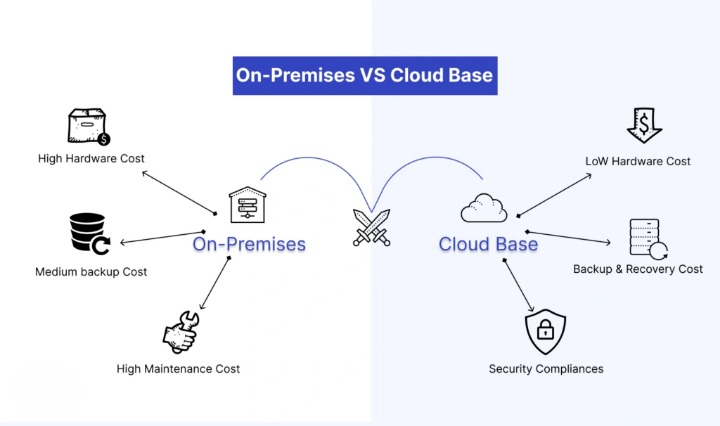
3. Cost Structure & ROI
4. Integration with Legacy Systems
5. Innovation & Future Readiness
The Real Question: Cloud, On-Premise, or Hybrid?
How SDH Helps Healthcare Organizations Modernize with Confidence
1. Business Consulting & Requirements Analysis
2. Strategic Planning & Roadmapping
3. Regulatory Compliance & Security Consulting
4. Workflow Optimization
5. Legacy System Modernization
Choosing the Right Path Forward
Cloud vs. On-Premise for Healthcare: Choosing the Right Modernization Path

Healthcare organizations today are under immense pressure to modernize. Rising patient expectations, growing data volumes, stricter regulations, cybersecurity threats, and the need for operational efficiency are forcing leaders to rethink their IT foundations.
At the center of this transformation lies a critical decision:
Should healthcare systems move to the cloud or remain on-premise?
There is no universal answer. But our guide provides a practical comparison of cloud vs. on-premise infrastructure for healthcare workloads—and explains how SDH helps organizations choose, plan, and execute the right modernization path.
What Is On-Premise Infrastructure?
On-premise systems are hosted within an organization’s own data centers. The healthcare provider owns and manages the hardware, software, security, and maintenance.
Common on-premise healthcare systems include:
- Legacy EHR platforms
- Radiology and imaging systems (PACS)
- Billing and claims systems
- Internal analytics platforms
What Is Cloud Infrastructure?
Cloud infrastructure is hosted by third-party providers and accessed over the internet. Resources are scalable, usage-based, and managed either fully or partially by the provider.
Typical cloud healthcare workloads include:
- Patient portals and engagement platforms
- Telehealth systems
- Analytics and AI-driven tools
- Data lakes and interoperability layers
Key Comparison: Cloud vs. On-Premise in Healthcare
1. Data Security & Compliance
On-Premise
- Full control over data location and access
- Familiar security models for compliance teams
- Requires internal expertise to maintain compliance with HIPAA, GDPR, and local regulations
- Security posture depends heavily on internal processes
Cloud
- Enterprise-grade security tooling and monitoring
- Built-in encryption, identity management, and audit logging
- Shared responsibility model can be misunderstood if not planned correctly
- Requires strong governance to ensure compliance alignment
Key Insight:
Cloud is not inherently less secure—but poorly governed cloud environments are risky. Compliance success depends on architecture, policies, and continuous oversight.
2. Scalability & Performance
On-Premise
- Scaling requires hardware procurement and long lead times
- Over-provisioning is common to handle peak demand
- Limited flexibility during sudden workload spikes
Cloud
- Elastic scaling for fluctuating patient demand
- Ideal for seasonal peaks, telemedicine growth, and analytics workloads
- Pay only for what you use
Key Insight:
Cloud excels where workload variability is high, while on-premise suits stable, predictable workloads.
3. Cost Structure & ROI
On-Premise
- High upfront capital expenditure (hardware, licenses)
- Ongoing maintenance, upgrades, and staffing costs
- Longer depreciation cycles
Cloud
- Operational expense model (subscription-based)
- Lower upfront investment
- Requires cost governance to avoid uncontrolled spending
Key Insight:
Cloud often reduces initial costs, but long-term savings depend on usage optimization and governance.
4. Integration with Legacy Systems
On-Premise
- Easier integration with existing legacy systems
- Fewer interoperability layers required
- Can slow innovation over time
Cloud
- Strong API and interoperability capabilities
- Requires careful migration planning
- Hybrid integration is often necessary
Key Insight:
Most healthcare organizations benefit from a hybrid model, combining cloud innovation with on-premise stability.
5. Innovation & Future Readiness
On-Premise
- Slower adoption of AI, automation, and analytics
- Manual upgrades and limited flexibility
- Suitable for compliance-heavy core systems
Cloud
- Faster access to AI, data analytics, and automation tools
- Enables population health analytics and predictive care
- Supports rapid experimentation and innovation
Key Insight:
Cloud accelerates innovation, but must be aligned with clinical and regulatory realities.
The Real Question: Cloud, On-Premise, or Hybrid?
For most healthcare organizations, the decision is not binary.
A hybrid approach often delivers the best results:
- On-premise for sensitive, latency-critical, or tightly regulated systems
- Cloud for analytics, patient engagement, scalability, and innovation
The challenge lies in designing the right architecture—not just choosing the technology.
How SDH Helps Healthcare Organizations Modernize with Confidence
At SDH, we approach cloud and on-premise decisions as strategic business transformations, not infrastructure upgrades.
1. Business Consulting & Requirements Analysis
We start by understanding:
- Clinical workflows
- Regulatory obligations
- Operational pain points
- Long-term business objectives
This ensures technology decisions align with real healthcare needs.
2. Strategic Planning & Roadmapping
SDH builds custom modernization roadmaps, defining:
- Which systems should move to the cloud
- Which should remain on-premise
- Where hybrid architectures deliver the most value
- Phased migration strategies to minimize risk
3. Regulatory Compliance & Security Consulting
We embed compliance and security into every architecture decision:
- HIPAA, GDPR, and regional healthcare regulations
- Secure data governance models
- Risk assessments and audit readiness
- Zero-trust and identity-driven security frameworks
4. Workflow Optimization
Modern infrastructure is only valuable if it improves outcomes.
SDH optimizes workflows to ensure:
- Reduced administrative burden
- Faster clinical processes
- Improved staff efficiency
- Better patient experiences
5. Legacy System Modernization
Rather than “rip and replace,” we:
- Modernize legacy systems incrementally
- Enable interoperability through APIs
- Reduce technical debt without disrupting care delivery
- Prepare systems for long-term scalability
Choosing the Right Path Forward
Cloud and on-premise are not competitors—they are tools. The real differentiator is how thoughtfully they are applied.
Healthcare organizations that succeed:
- Align infrastructure with strategy
- Balance compliance with innovation
- Modernize without disrupting patient care
- Plan for scalability and long-term resilience
SDH acts as a trusted partner throughout this journey, helping healthcare leaders make informed decisions, reduce risk, and unlock sustainable growth through smart modernization.
Categories
Share






Need a project estimate?
Drop us a line, and we provide you with a qualified consultation.