
1. Django’s “Batteries Included” Philosophy
Built-in Admin Interface
Authentication and Authorization
URL Routing & Middleware
2. Python + Django: A Developer-Friendly Duo
Readable, Maintainable Code
Rich Python Ecosystem
3. Reusable Components & Modular Architecture
Reusable Apps & Libraries
4. Scalable Architecture for Future Growth
Model-Template-View (MTV) Pattern
ORM (Object-Relational Mapper)
5. Security Built Into the Framework
Out-of-the-Box Protections
6. Testing Tools That Save Time and Boost Confidence
7. The SDH Advantage: Building MVPs with Python & Django
Conclusion
What Makes Django Ideal for Rapid MVP Development

Every great product starts with validation. The real question isn’t just “Can we build this?” — it’s “How fast can we launch and test it in the real world?”
At the MVP stage, speed matters. But so does building on a foundation that won’t break once users start coming in. Move too slowly, and you lose momentum. Cut too many corners, and you’ll end up rebuilding everything.
That’s why choosing the right technology stack is critical from day one.
We’ll explore why Django is ideal for rapid MVP development — and how it helps companies reach the market faster with confidence.
1. Django’s “Batteries Included” Philosophy
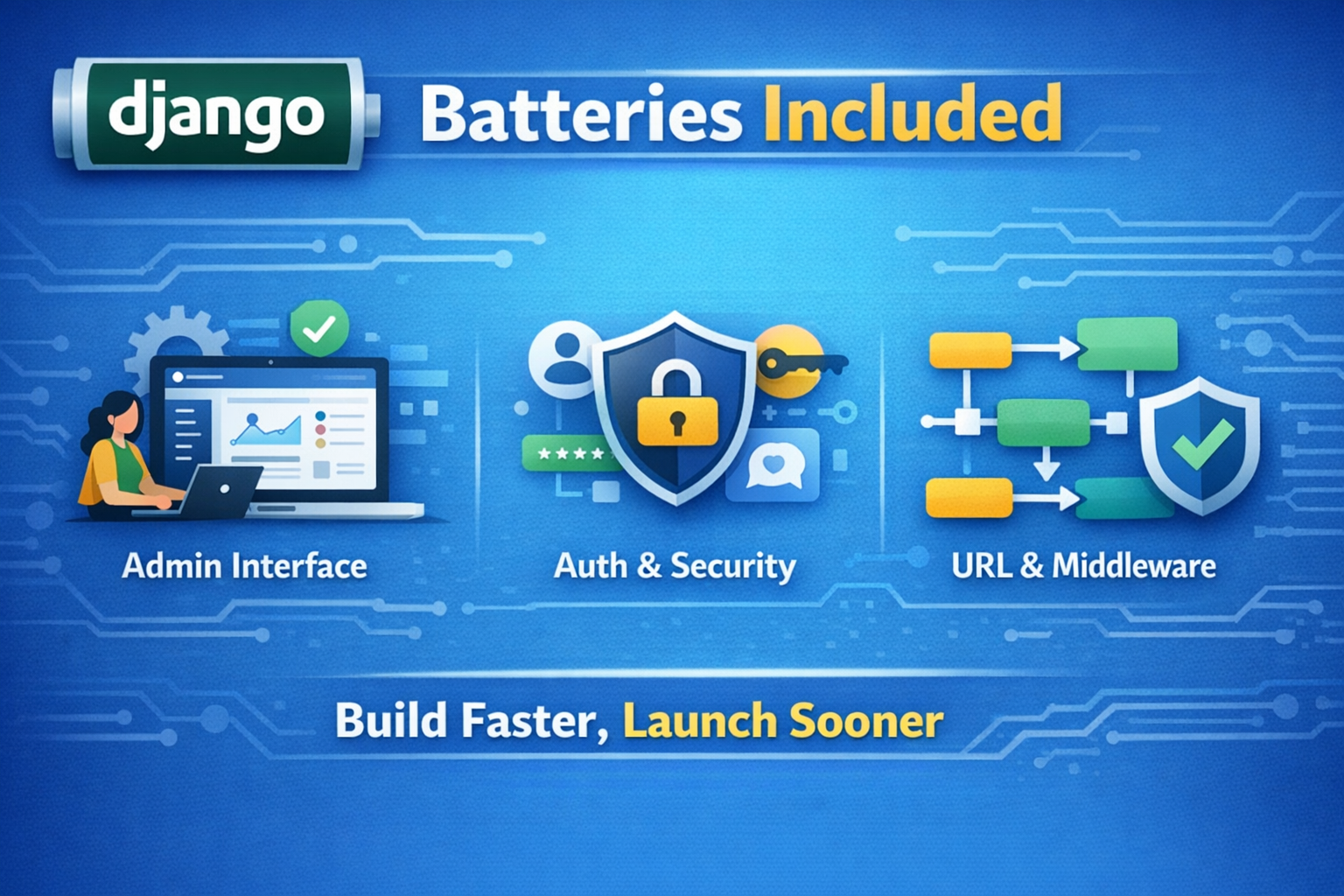
One of Django’s most compelling advantages is its full-featured framework — sometimes described as “batteries included.” Unlike minimalist frameworks that require assembling dozens of libraries manually, Django comes ready-made with a suite of essential components developers need to build web applications fast.
Built-in Admin Interface
- Automatically generates a secure, fully functional admin dashboard based on your data models.
- Eliminates weeks of backend tooling development that many startups waste precious time building from scratch.
- Allows founders or product owners to easily manage users, content, and data without additional code.
Authentication and Authorization
- Django includes a robust authentication system out of the box.
- Features such as user registration, login/logout, session management, password resets, and permission controls are available without third-party plugins.
- This dramatically reduces early development overhead and allows developers to focus on core product features.
URL Routing & Middleware
- Django’s intuitive URL dispatching system and middleware support help structure requests and responses efficiently.
- Developers can define clean, readable URLs and introduce custom processing layers (like logging, security, or response transforms) without additional setup.
These features let teams eliminate repetitive setup tasks and launch functional MVPs faster — without compromising on structure or reliability.
2. Python + Django: A Developer-Friendly Duo
At its core, Django is built on Python — one of the most popular, readable, and beginner-friendly programming languages in the world. Python’s clear syntax and expressive nature translate into faster development cycles because developers spend less time wrestling with language complexity and more time building features.
Readable, Maintainable Code
- Python code is clean and highly maintainable — which makes onboarding new developers or iterating on features easier as your product evolves.
- This readability is a huge advantage during MVP development when teams must adapt quickly based on feedback.
Rich Python Ecosystem
- Python’s ecosystem includes a vast range of reusable libraries and frameworks — from data processing and background jobs to APIs and authentication.
- Many Django projects use additional Python tools like Celery for background tasks or Django REST Framework for APIs — boosting productivity without reinventing the wheel.
By building your MVP with a language that developers love and understand, you accelerate development and reduce technical risk early on.
3. Reusable Components & Modular Architecture
Django encourages a modular application structure where each functionality can be organized into separate "apps" — reusable components that can be plugged into your project as needed.
Reusable Apps & Libraries
- Django projects are composed of smaller pieces called “apps,” each handling a specific feature (e.g., authentication, payments, messaging).
- These apps can be reused across projects or backward-integrated from past work — saving time and reducing duplicated effort.
- Third-party Django apps extend capabilities instantly (e.g., social login, content management, e-commerce tools).
This modularity means your MVP doesn’t need to start from a blank slate — you’re assembling proven building blocks for rapid delivery.
4. Scalable Architecture for Future Growth
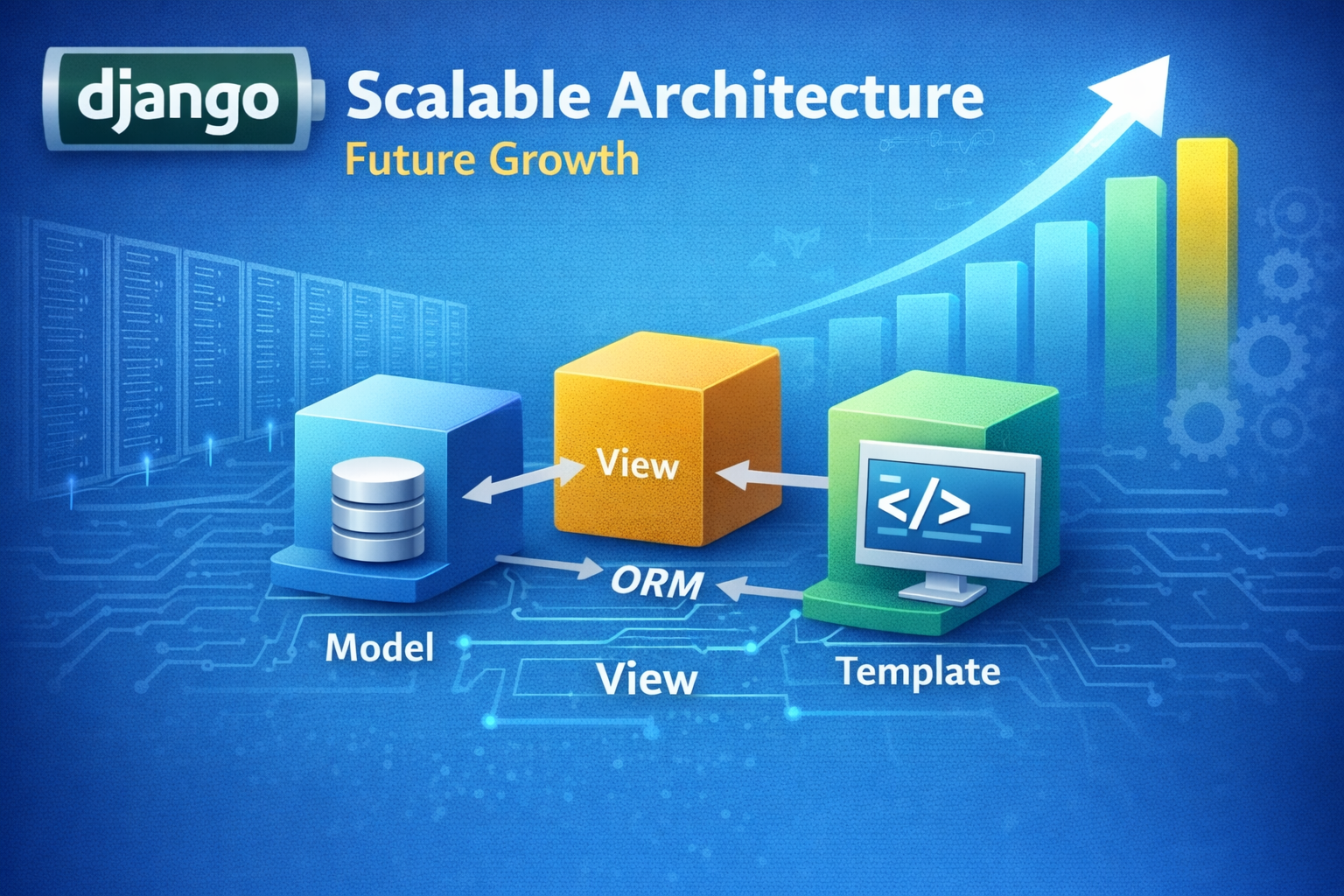
Rapid MVP delivery shouldn’t come at the expense of long-term viability. Django’s architecture provides scalability that supports growth beyond the MVP stage.
Model-Template-View (MTV) Pattern
- Django’s separation of concerns — data (Model), logic (View), and presentation (Template) — keeps code organized and maintainable.
- This makes future changes, feature expansions, and scaling easier as your product evolves.
ORM (Object-Relational Mapper)
- Django’s built-in ORM allows developers to interact with databases using Python instead of SQL.
- This simplifies database design, migrations, and future schema changes — a valuable advantage when your MVP pivots based on user insights.
Django’s scalability and code organization help ensure your MVP lays a solid foundation for future product iterations — saving time and cost down the road.
5. Security Built Into the Framework
Security is a critical concern — even for MVPs. Django has strong security measures integrated into the framework, giving startups peace of mind without requiring security specialists early on.
Out-of-the-Box Protections
- Defends against common vulnerabilities like SQL injection, cross-site scripting (XSS), and cross-site request forgery (CSRF).
- Includes secure authentication and password hashing mechanisms.
- Django’s security updates and patches are regularly maintained by a dedicated community.
By baking security into the development process, Django helps teams deliver trustworthy MVPs with fewer risks and less engineering overhead.
6. Testing Tools That Save Time and Boost Confidence
Testing is essential for MVPs — especially when you’re iterating quickly and deploying frequently. Django includes a built-in testing framework that allows developers to:
- Write automated unit and integration tests.
- Run tests using familiar Python tools.
- Catch bugs earlier, reducing time spent in manual QA cycles.
This level of built-in support minimizes errors and improves product quality — helping teams iterate faster.
7. The SDH Advantage: Building MVPs with Python & Django
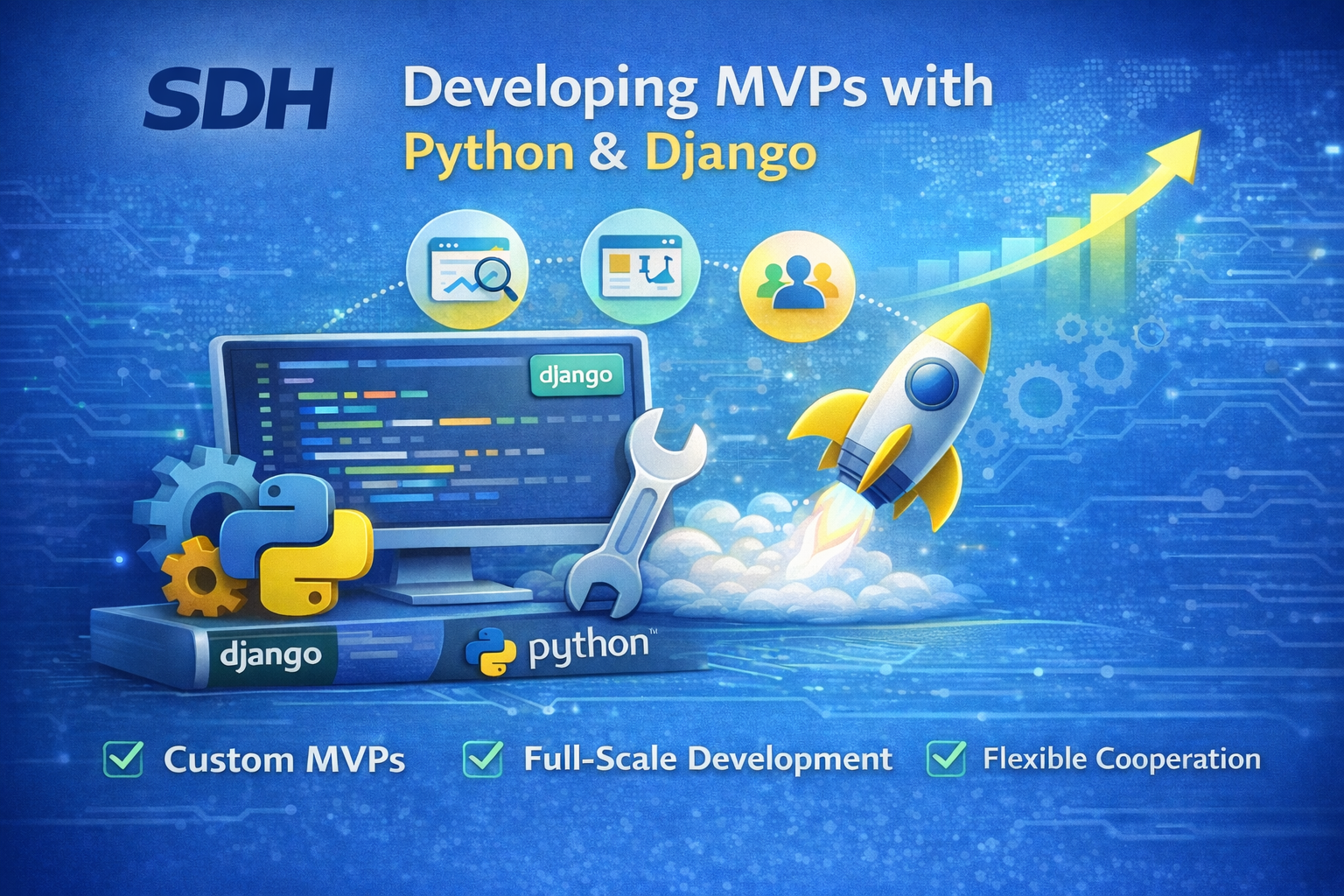
At SDH Global, we specialize in Python and Django development from MVP to full-scale product launch. Our experienced developers provide:
✔ Custom MVP development using Django that prioritizes speed and scalability.
✔ End-to-end software development services — from business analysis and UX/UI design to deployment and ongoing support.
✔ Flexible cooperation models tailored to your project size and goals.
Whether you need to validate a new idea or launch a scalable web product, Django’s built-in features, reusable components, and rapid development capabilities make it an ideal choice — and SDH has the expertise to bring your vision to life.
Conclusion
Building an MVP demands speed, clarity, and technical reliability. Django delivers all of this:
- Rich built-in features that remove boilerplate work.
- Reusable, modular code that accelerates development.
- Proven tools for database management, security, and administration.
- Scalable architecture that supports future growth.
By choosing Django — and partnering with a skilled team like SDH — you can dramatically shorten time to market, validate your concept fast, and build a solid foundation for your product’s evolution.
Ready to start your MVP journey? Let’s build something exceptional together.
Categories
About the author

Python Developer at Software Development Hub with over 4.5 years of experience. He designs, develops, and maintains robust applications of various sizes. Adept at building APIs, integrating third-party services, and leveraging modern development tools.
Share





Need a project estimate?
Drop us a line, and we provide you with a qualified consultation.