
Why Personalization Matters in Modern E-Commerce
Customer Expectations Have Changed
Benefits of Personalization for Businesses
What Are AI Product Recommendation Systems?
How AI Recommendation Engines Work
Types of AI Recommendation Systems Used in E-Commerce
Collaborative Filtering
Content-Based Filtering
Hybrid Recommendation Systems
Two-Stage Technical Architecture
Key Benefits of AI Personalization in E-Commerce
Improved Customer Experience
Higher Conversion Rates
Increased Revenue and Customer Loyalty
Real-World Use Cases of AI in E-Commerce
Product Recommendations
Personalized Email Campaigns
Smart Search and Product Discovery
Dynamic Pricing Optimization
How AI Improves Product Recommendations
Customer Behavior Analysis
Real-Time Recommendation Updates
How to Build an AI Recommendation System for E-Commerce
Challenges of Implementing AI in E-Commerce
Data Quality Issues
Integration Complexity
Privacy and Security Concerns
How Businesses Can Get Started with AI Personalization
How SDH Helps Businesses Build AI Recommendation Systems
Custom AI Recommendation System Development
AI Integration into Existing E-Commerce Platforms
End-to-End AI Development Services
Scalable and Secure AI Solutions
Future Trends of AI Personalization in E-Commerce
To Conclude
AI in E-Commerce: Personalization and Product Recommendations


Amazon generates 35% of its revenue—approximately $70 billion annually—from AI-powered product recommendations. This statistic reflects a broader shift in e-commerce, where 73% of customers now expect better personalization as technology advances. When businesses fail to meet these expectations, 76% of customers express frustration.
This article explores how AI is shaping eCommerce personalization using AI, the types of recommendation systems available, and how SDH helps businesses implement custom solutions.
Why Personalization Matters in Modern E-Commerce
In the past, online stores relied on generic product listings, hoping customers would find what they needed. Today, personalization is no longer optional—it's a requirement.
Research indicates that 71% of consumers expect companies to deliver personalized interactions, while 76% express frustration when businesses fail to meet these expectations.
Customer Expectations Have Changed
Modern consumers expect experiences that feel relevant to them. A shopper browsing a website wants suggestions that match their tastes, purchase history, and browsing behavior. Platforms like Amazon have set high standards, showing that generic shopping experiences are no longer effective.
Benefits of Personalization for Businesses
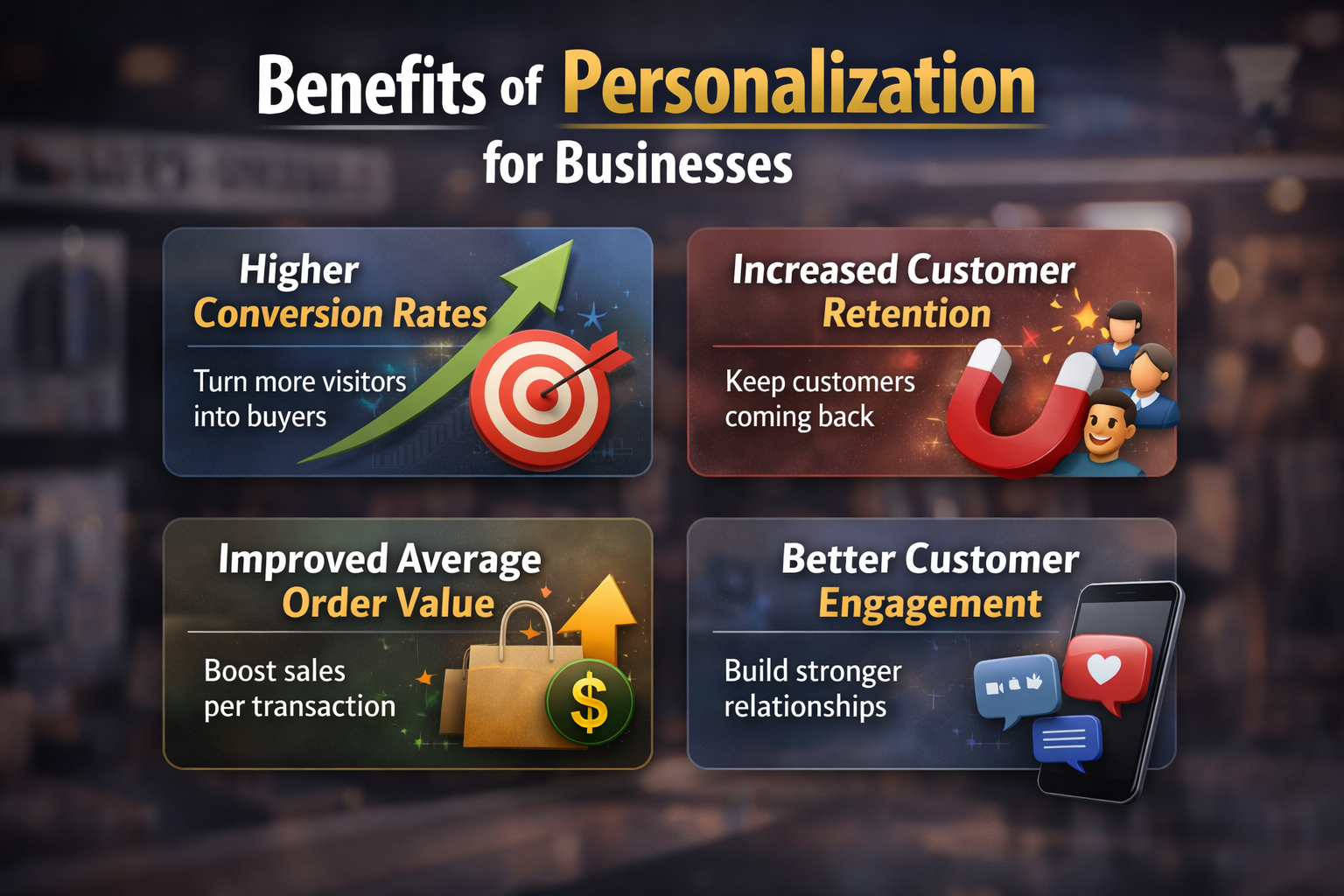
Implementing AI-driven personalization offers measurable business benefits:
- Higher Conversion Rates
- Increased Customer Retention
- Improved Average Order Value
- Better Customer Engagement
With AI, businesses can deliver a personalized shopping experience that drives revenue and strengthens customer relationships.
What Are AI Product Recommendation Systems?
AI product recommendation systems are algorithms designed to predict what products a customer is likely to purchase based on their behavior, preferences, and interactions. These systems leverage machine learning models, predictive analytics, and large datasets to generate highly relevant suggestions in real-time.
How AI Recommendation Engines Work
AI recommendation engines work by analyzing:
- Customer Behavior Tracking: Browsing history, search queries, and purchase patterns.
- Machine Learning Models: Algorithms learn from data to predict customer preferences.
- Real-Time Data Processing: Recommendations adapt instantly to a shopper's actions.
These machine learning recommendation systems ensure that every interaction is optimized to increase engagement and sales.
Types of AI Recommendation Systems Used in E-Commerce

Collaborative Filtering
Collaborative filtering relies on user behavior and similarities between customers. It suggests products based on what other users with similar preferences have purchased.
The system operates purely on behavioral data without requiring detailed product specifications. Two primary variants exist:
- User-based filtering computes similarities between individual users and all others in the dataset
- Item-based filtering determines product similarities based on user interactions rather than product characteristics
Content-Based Filtering
Content-based filtering focuses on product attributes and user preferences. It recommends items similar to what a customer has interacted with previously, ensuring relevance.
Hybrid Recommendation Systems
Hybrid recommendation engines combine both collaborative and content-based approaches. This hybrid recommendation engine method is especially effective for large platforms with diverse products, offering the most accurate personalization.
Two-Stage Technical Architecture
Recommendation systems typically implement a two-stage processing structure. The first stage—candidate generation—identifies a broad set of potentially relevant products from the complete catalog. This phase prioritizes processing speed over precision, surfacing 100-500 candidate products through rapid similarity calculations. For a 50,000-product catalog, candidate generation narrows options to manageable subsets within 50 milliseconds.
The second stage handles product ranking, where algorithms score each candidate across multiple factors. The system evaluates user relevance, inventory availability, profit margins, seasonal trends, and operational constraints including shipping costs and fulfillment capabilities. Top-scoring products appear to customers in real-time, adapting based on current session context.
Key Benefits of AI Personalization in E-Commerce
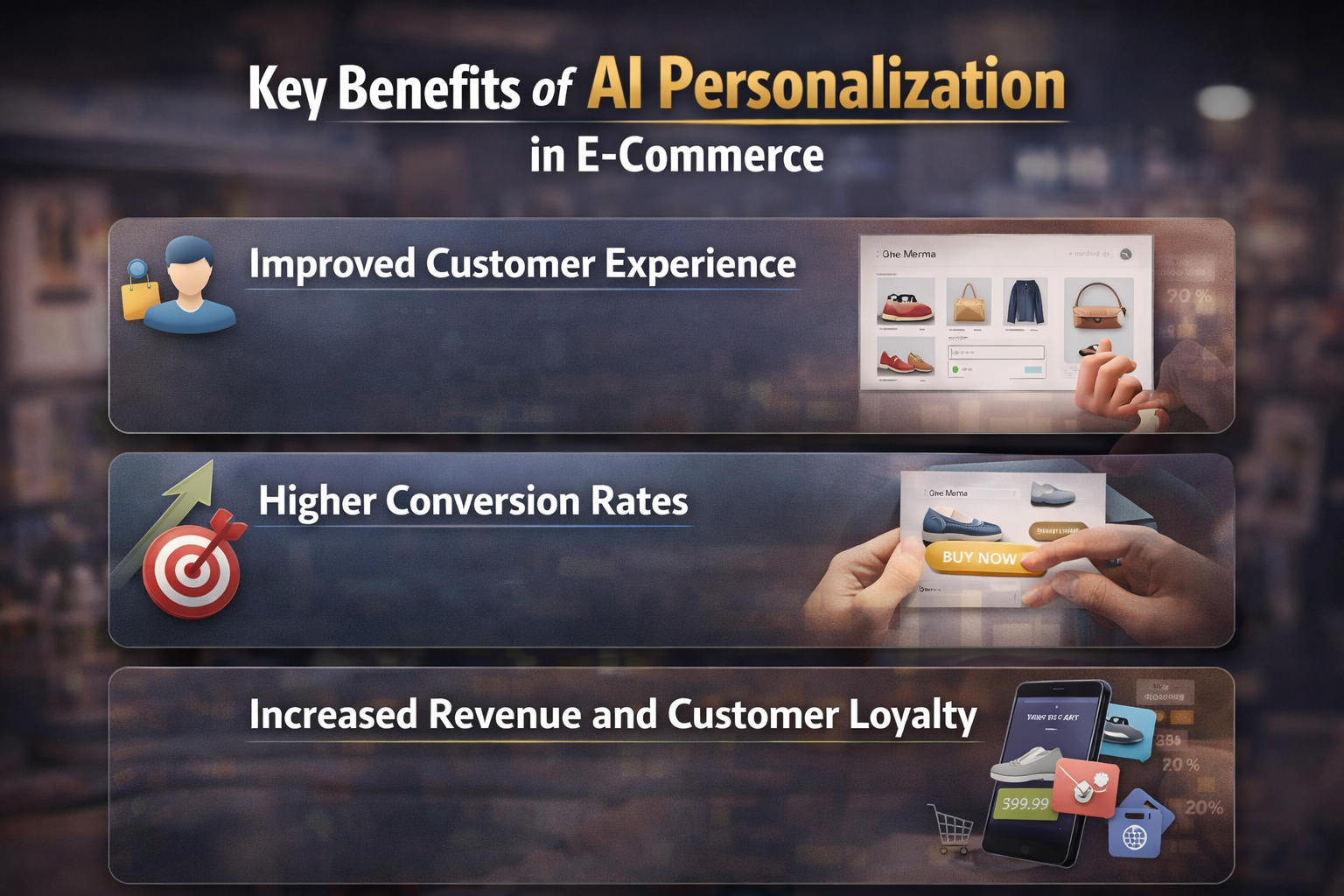
Improved Customer Experience
AI enables platforms to provide relevant product suggestions, personalized homepages, and tailored promotions, creating a more enjoyable shopping experience.
Higher Conversion Rates
By delivering more relevant recommendations, AI reduces decision time and increases the likelihood of purchase.
Increased Revenue and Customer Loyalty
AI facilitates upselling and cross-selling, boosting average order value and encouraging repeat business. Leveraging AI-driven product recommendations transforms casual visitors into loyal customers.
Real-World Use Cases of AI in E-Commerce
Product Recommendations
Common examples include:
- “Customers also bought”
- “Recommended for you”
Personalized Email Campaigns
AI targets emails based on behavior, preferences, and purchase history, increasing engagement and conversion.
Smart Search and Product Discovery
AI enhances search functionality, offering relevant suggestions and autocomplete options to improve product discovery.
Dynamic Pricing Optimization
AI analyzes user behavior and market trends to optimize pricing in real-time, maximizing sales and profits.
These AI use cases in eCommerce demonstrate the versatility and power of personalization technologies.
How AI Improves Product Recommendations
Customer Behavior Analysis
AI evaluates browsing patterns, purchase history, and engagement metrics to segment users and anticipate needs.
Real-Time Recommendation Updates
AI systems adjust instantly, ensuring real-time personalization and providing customers with the most relevant products at any moment.
By combining predictive analytics with continuous learning, AI helps businesses offer consistently effective recommendations.
How to Build an AI Recommendation System for E-Commerce
Building a robust system involves several key steps:
- Define Business Goals: Identify what you want to achieve with personalization.
- Collect and Prepare Data: Gather accurate, relevant customer and product data.
- Choose Recommendation Model: Decide between collaborative, content-based, or hybrid approaches.
- Train Machine Learning Models: Use historical data to optimize predictions.
- Deploy and Test System: Integrate with your e-commerce platform and validate performance.
- Optimize Continuously: Update models based on feedback and changing trends.
For businesses looking to build AI recommendation systems, following this structured approach ensures success and scalability.
Challenges of Implementing AI in E-Commerce
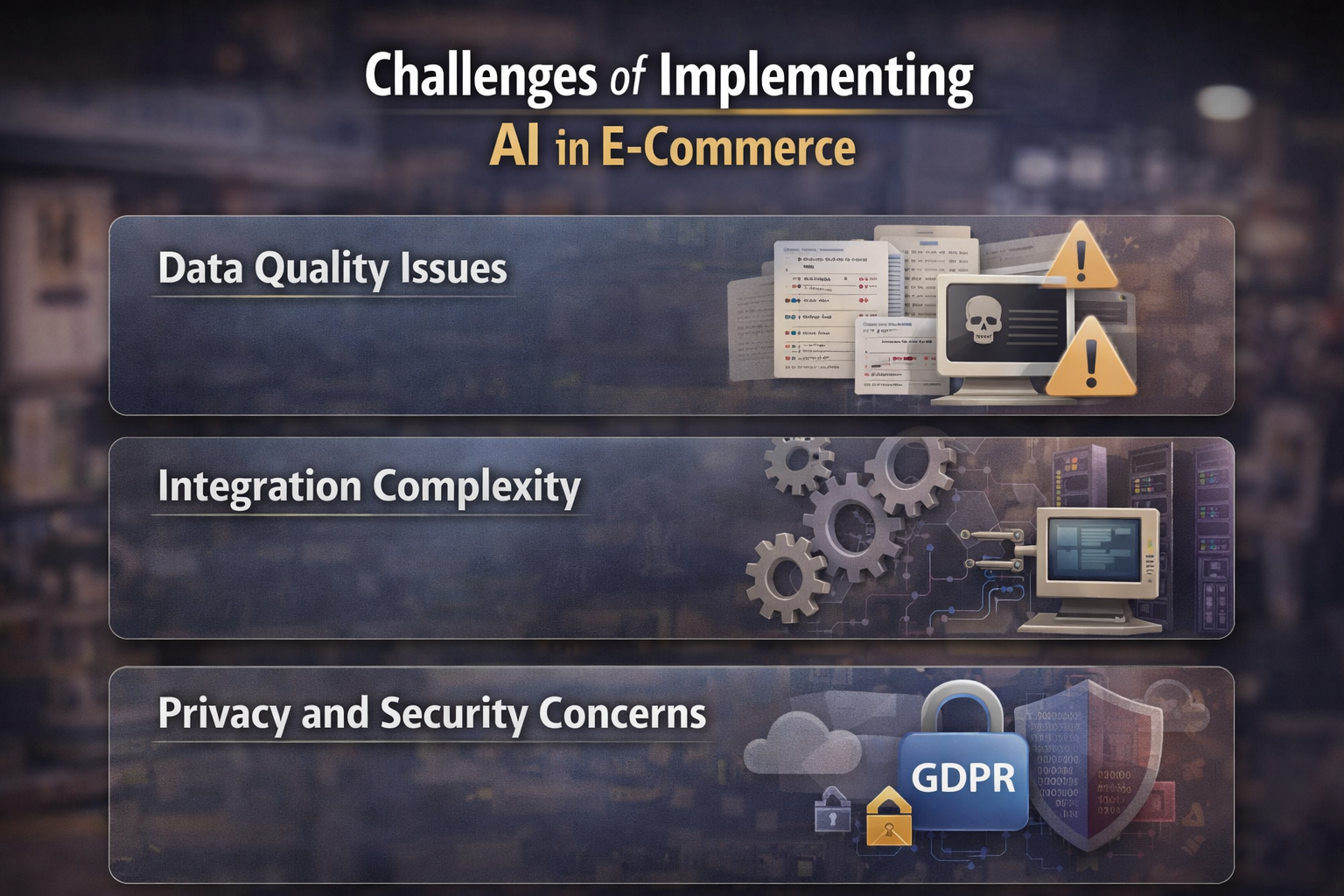
Data Quality Issues
Poor or incomplete data can lead to ineffective recommendations, highlighting the need for clean, structured datasets.
Integration Complexity
AI systems must integrate seamlessly with existing e-commerce platforms, which can be difficult with legacy infrastructure.
Privacy and Security Concerns
Compliance with regulations like GDPR is essential to protect customer data and maintain trust.
Addressing these AI implementation challenges is critical for a successful deployment.
How Businesses Can Get Started with AI Personalization
To start leveraging AI personalization:
- Assess your readiness based on data quality and platform capabilities.
- Identify the segments of your business that will benefit most from AI.
- Develop a clear AI personalization strategy to guide implementation.
Early adoption can provide a competitive advantage in the crowded e-commerce market.
How SDH Helps Businesses Build AI Recommendation Systems
Custom AI Recommendation System Development
SDH develops tailored recommendation engines with algorithms customized to your business needs, ensuring highly relevant suggestions.
AI Integration into Existing E-Commerce Platforms
Whether using Shopify, Magento, or a custom platform, SDH ensures smooth integration with minimal disruption.
End-to-End AI Development Services
From data preparation to model development, deployment, and continuous optimization, SDH delivers complete AI solutions.
Scalable and Secure AI Solutions
SDH builds cloud-ready, secure systems optimized for performance, allowing businesses to scale confidently.
By partnering with SDH, businesses can access AI recommendation engine development services that drive engagement, sales, and customer satisfaction.
Future Trends of AI Personalization in E-Commerce
The evolution of AI in e-commerce continues rapidly:
- Generative AI Personalization: AI creating new, unique product suggestions.
- Multimodal AI: Combining images, text, and user behavior for recommendations.
- Voice Commerce: Personalized experiences through voice assistants.
- Predictive Shopping: Anticipating customer needs before they search.
These trends shape the future of AI in eCommerce, promising even deeper personalization and smarter shopping experiences.
To Conclude
AI personalization is no longer a luxury—it’s a necessity for modern e-commerce. Businesses that adopt AI early can deliver personalized shopping experiences, increase conversions, and strengthen customer loyalty. AI product recommendation systems help retailers stay competitive and responsive to customer expectations.
Partnering with experts like SDH ensures your AI implementation is robust, secure, and tailored to your unique business needs.
Explore how custom AI solutions can transform your e-commerce platform today.
Categories
About the author

CTO & co-founder at Software Development Hub. Software engineer with 20+ years of experience. Python/Django-geek, software architect and IT team leader. Staying up-to-date with tech trends. Strong technical skills and diverse expertise in software structure design, development, team management and cybersecurity.
Share






Need a project estimate?
Drop us a line, and we provide you with a qualified consultation.