How SDH Integrated Pharmacy Robotics With National E-Health Systems — A Healthcare Case Study



Healthcare organizations are increasingly investing in automation technologies to improve operational safety, efficiency, and accuracy.
Pharmacy robotics, enterprise resource systems, and national digital health platforms are now critical components of modern healthcare delivery. However, the true value of these technologies depends not on their individual capabilities, but on how effectively they work together.
This case study highlights how Software Development Hub designed and delivered a scalable integration framework that connected pharmacy robotics with enterprise systems and a restricted national e-health platform — transforming isolated technologies into a unified operational ecosystem.
The Starting Point: Advanced Automation Without System Connectivity
The hospital environment already included advanced automation technology.
KiroLink, a pharmacy robot, was introduced to handle medication storage, retrieval, and dispensing. Its role was to reduce manual handling, improve dispensing accuracy, and accelerate pharmacy workflows.
While the robot functioned reliably, the surrounding workflow remained fragmented.
Medication orders originated within hospital systems. Inventory and transaction records were maintained in ERP. Patient data was recorded within a national e-health platform. Without direct integration between these systems, staff were still transferring data manually between platforms.
This manual coordination created several operational risks:
- Workflow delays during peak hours
- Increased possibility of transcription errors
- Limited real-time visibility into medication flows
- Reduced efficiency despite automation investment
The situation revealed a familiar pattern in healthcare digital transformation: automation alone does not eliminate manual work — integration does.
The Core Complexity: A Restricted National E-Health Platform
The integration challenge became significantly more complex due to the presence of a restricted national e-health system, serving as the hospital’s central HIS.
Access to this system was tightly controlled. Only a limited number of vendors were permitted to integrate directly with its infrastructure. This created a barrier that required both technical expertise and institutional coordination.
Rather than introducing temporary solutions or isolated workarounds, SDH adopted a collaborative integration strategy.
The engineering team worked directly with the national platform stakeholders to co-author the API specification, establishing a secure and standardized communication pathway between systems.
This step was critical. Without a formal API structure, reliable automation across systems would not have been possible.
More importantly, this collaboration created a reusable framework capable of supporting future integrations across additional facilities.
The Integration Strategy: One Middleware Layer, Three Systems
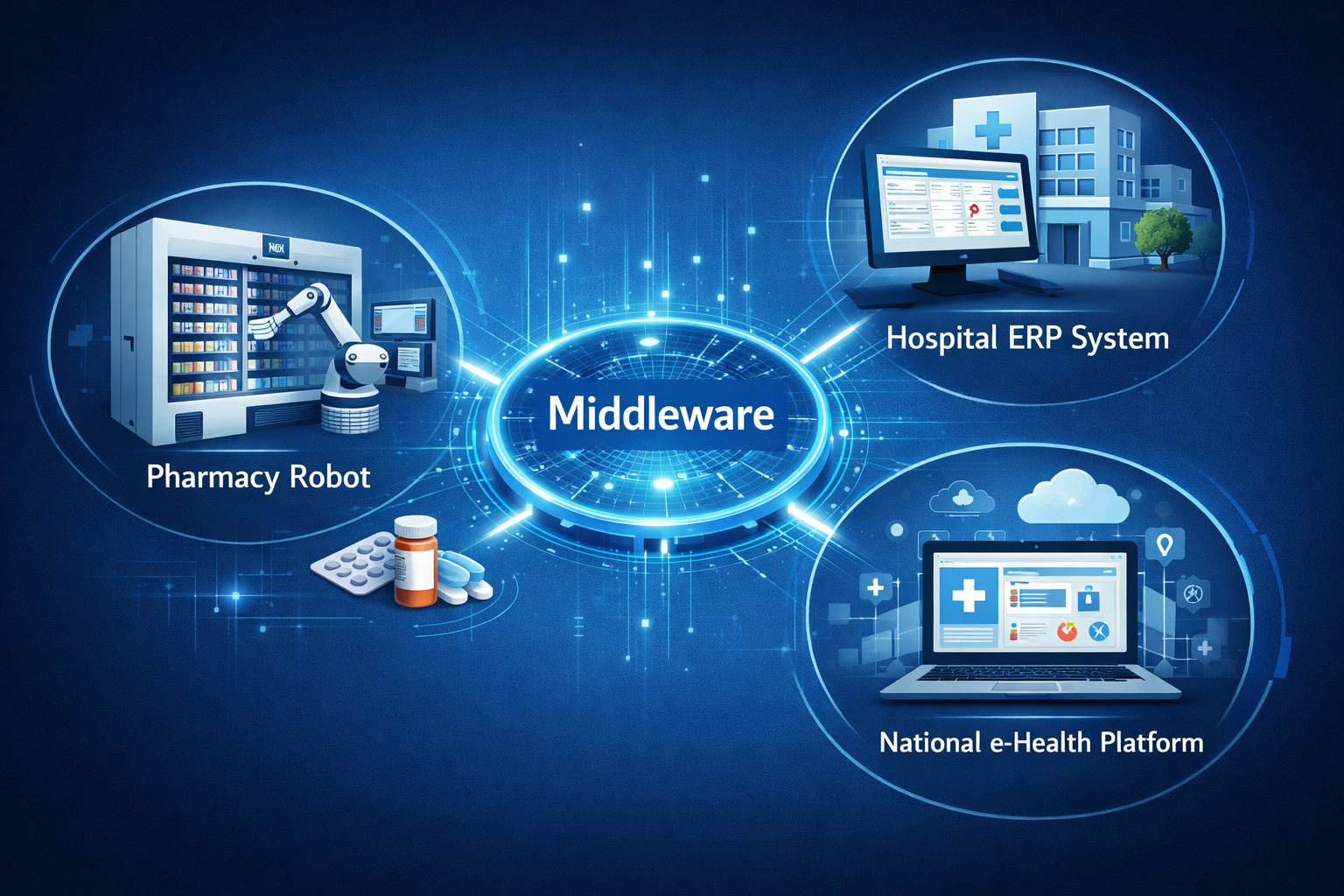
To unify the workflow environment, SDH engineered a centralized middleware layer capable of managing communication across multiple systems.
Instead of building multiple direct connections — which can become fragile and difficult to maintain — middleware provided a scalable integration architecture that centralized communication and ensured consistent data exchange.
The middleware connected:
- The KiroLink pharmacy robot
- The hospital ERP system
- The national e-health platform
Once implemented, pharmacy workflows transitioned from fragmented coordination to synchronized automation.
A clinician submits a medication order.
The robot retrieves and dispenses medication.
The ERP system updates inventory records automatically.
The national platform logs patient information in real time.
All systems operate as part of a unified workflow — without manual data transfer.
Real-Time Visibility Across the Dispensing Lifecycle
Operational transparency was an essential part of the solution.
A live monitoring dashboard was introduced to provide full visibility across the medication lifecycle. This enabled pharmacy managers to track workflows from order initiation to final dispensing in real time.
This level of visibility improved:
- Workflow reliability
- Inventory accuracy
- Operational response time
- System-level accountability
With complete lifecycle visibility, pharmacy operations shifted from reactive to proactive management.
Built for Replication Across Public Hospitals
One of the defining characteristics of this project was its focus on scalability.
Many healthcare integration projects succeed within a single facility but struggle when expansion begins. This often occurs because the underlying architecture was designed for isolated deployment rather than long-term growth.
This solution was engineered differently.
From the outset, the middleware architecture was designed to support multi-site adoption. New hospitals, new devices, and additional automation systems could be connected without rebuilding the system core.
Following initial deployment, the solution was successfully adopted across public hospitals. The next phase involves national replication — expanding the integration framework to additional sites and introducing new pharmacy automation technologies beyond the original implementation.
This design ensures that expansion remains predictable, controlled, and efficient.
Implementation Outcomes
The project delivered measurable results across operational and technical dimensions.
System Connectivity
- Three mission-critical systems successfully integrated
- Secure connection established with a restricted national e-health platform
- Custom API specification co-authored to enable structured communication
Workflow Automation
- Full dispensing lifecycle automated
- Manual handoffs eliminated
- Real-time synchronization achieved across platforms
Deployment Progress
- Successfully adopted across public hospitals
- National-scale rollout underway
Delivery Metrics
- 1,560 hours of development effort
- 39 weeks from design to production
- Architecture designed for long-term scalability
These outcomes demonstrate how strategic integration planning directly influences operational performance and long-term technology value.
Integration as Strategic Infrastructure
Healthcare environments continue to evolve toward increasingly interconnected systems. Robotics, ERP platforms, digital health infrastructure, and clinical applications must function as a cohesive ecosystem to deliver measurable impact.
Integration architecture plays a central role in enabling this transformation.
Well-designed middleware environments create:
- Standardized workflows
- Reduced operational risk
- Improved data reliability
- Faster onboarding of new technologies
- Sustainable infrastructure growth
Rather than serving as a temporary solution, middleware becomes a long-term foundation for digital healthcare operations.
The SDH Contribution: Engineering Systems That Scale
This project represents a large-scale integration initiative delivered by SDH, a technology partner specializing in enterprise-grade healthcare solutions and system interoperability.
Through close collaboration with national platform stakeholders and hospital systems, SDH delivered a unified architecture capable of supporting both operational efficiency and national-level expansion.
The result is not just a connected pharmacy workflow — but a scalable infrastructure capable of evolving alongside healthcare technology demands.
From Local Implementation to National Capability
What began as a single hospital automation initiative evolved into a scalable operational model capable of supporting national healthcare infrastructure.
New facilities can be integrated without redesigning systems.
New pharmacy technologies can be introduced without disrupting workflows.
New operational requirements can be addressed without rebuilding the architecture.
One hospital became the starting point.
Three systems became one synchronized workflow.
Manual processes became automated infrastructure.
And the foundation is now ready to support continued growth.
Categories
About the author

CEO & Co-Founder at Software Development Hub. Innovation-driven expert with 20+ years of experience. A business practitioner with experience in creating and launching startups, an innovator and progressive-minded specialist, who helps turn raw ideas into profitable results.
Share





Need a project estimate?
Drop us a line, and we provide you with a qualified consultation.