
How AI and ML relate
Why this distinction matters for services
Comparison table: Use cases for AI vs. ML
How to choose AI vs. ML development services
Combined AI/ML implementation strategies
Which technology to pick and why
Current trends to watch
Quick checklist for your RFP (ai and machine learning development services)
How SDH Can Help You
AI and Machine Learning Development Services: Key Differences and When to Use Each

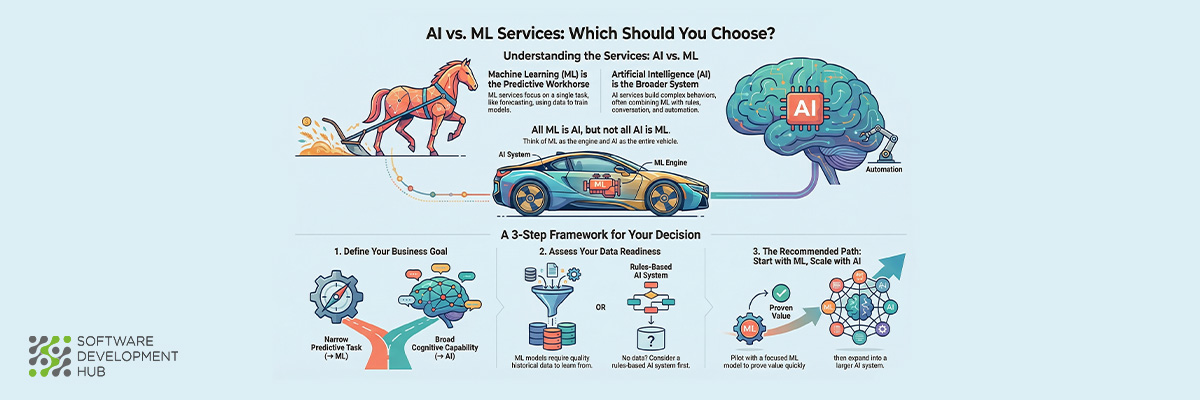
Whether you’re a product manager, CTO, or business owner, choosing between AI and machine learning (ML) — or deciding how to combine both — can feel like navigating two overlapping maps.
Let’s break down the difference between AI and ML, give a clear comparison of use cases, offer a decision framework to choose the right path, and outline combined AI/ML implementation strategies with real-world industry examples and best practices.
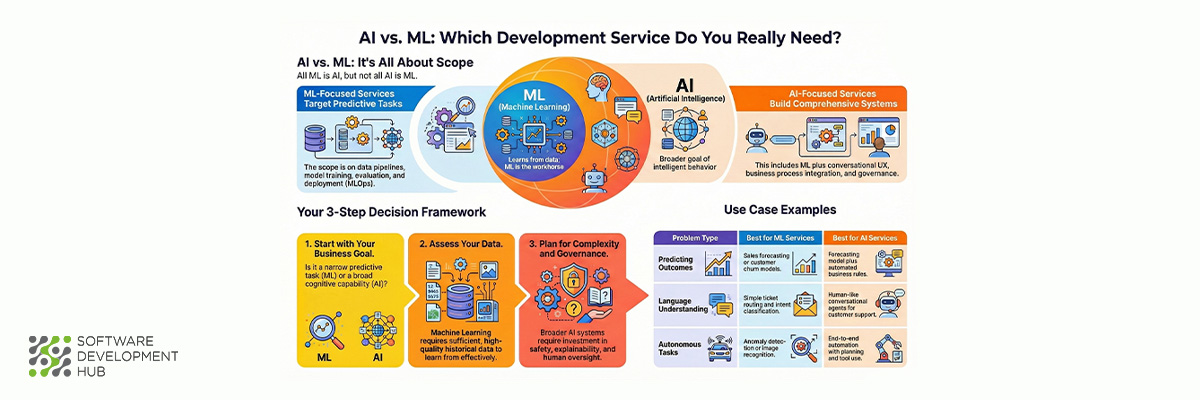
How AI and ML relate
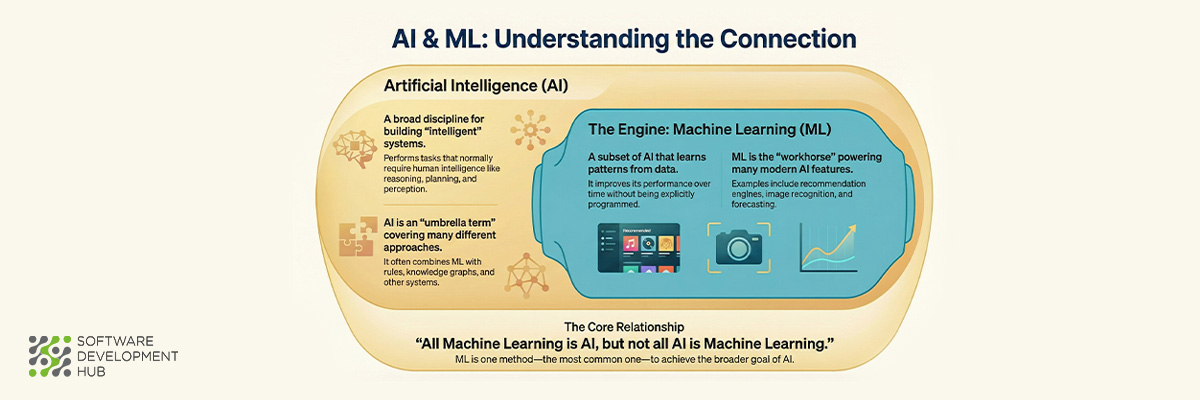
- Artificial Intelligence (AI) is the broad discipline of building systems that perform tasks which normally require human intelligence — reasoning, planning, language understanding, perception, and decision-making. AI is an umbrella term that covers many approaches and technologies.
- Machine Learning (ML) is a subset of AI. ML builds systems that learn patterns from data and improve performance over time without being explicitly programmed for every rule. In practice, ML powers many AI features (image recognition, recommendation engines, forecasting).
Put simply: all ML is AI, but not all AI is ML. ML is the workhorse that extracts predictive power from data; AI is the broader goal of building “intelligent” behavior, often combining ML with rules, knowledge graphs, and systems integration.
Why this distinction matters for services
When you buy ai and machine learning development services, you’re choosing between different scopes of work:
- An ML-focused engagement typically centers on data pipelines, model selection/training, evaluation, and deployment (MLOps).
- An AI-focused engagement might include ML plus knowledge engineering, conversational UX, multi-component systems (agents, planners), integrations with business processes, and governance (safety, compliance, explainability).
Knowing which you need avoids wasted scope and speeds time-to-value.
Comparison table: Use cases for AI vs. ML
|
Problem type |
Typical ML solution |
Typical AI solution |
When to pick which |
|
Predicting numeric/ categorical outcomes (sales forecast, churn) |
Supervised ML (regression/classification) |
ML model plus business rules & automation |
ML-first — fast ROI if you have clean historical data |
|
Real-time personalization (recommendations) |
Collaborative / content-based ML models |
ML plus AI orchestration, context-aware agents |
ML-first, scale to AI if you need cross-channel intelligence |
|
Natural language understanding (search, helpdesk) |
NLP models (intent classification, embeddings) |
Conversational AI/agents combining retrieval, generative models, business logic |
AI if you need a human-like conversational flow; ML for simple routing/classification |
|
Computer vision (inspection, detection) |
CNN/transformer-based models |
Vision + decision systems (alerting, robotic action) |
ML for detection; AI for end-to-end automation |
|
Content generation (marketing copy, code) |
Fine-tuned generative models |
Generative AI with guardrails, prompting systems, human-in-the-loop review |
AI — generative capabilities are the driver |
|
Rule-based decision automation (compliance checks) |
ML for scoring anomalies |
AI combining rules engine + ML anomaly detection |
AI if rules are complex and need explanation; ML for pattern scoring |
|
Multi-step autonomous tasks (agents) |
ML components |
Agentic AI (planning, monitoring, tool use) |
AI — needs orchestration beyond single models |
This table is a practical shortcut — most real systems are hybrid, combining ML models with AI components, rule engines, and integration layers.
How to choose AI vs. ML development services
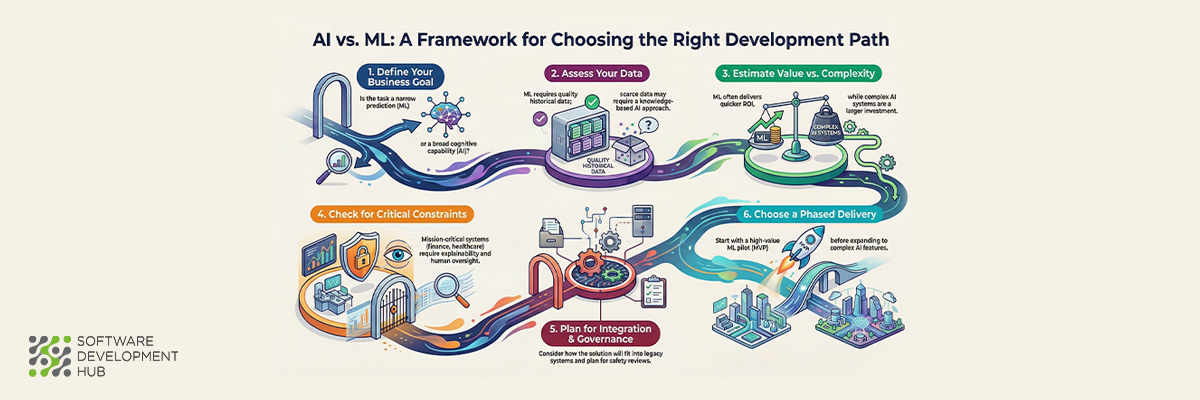 Follow these steps to pick the right approach.
- Start with the business question.
Is the goal a narrow predictive task (e.g., reduce churn by 10%) or a broader cognitive capability (e.g., automate customer support end-to-end)? Narrow → ML. Broad → AI.
- Assess data quality & quantity.
ML needs labeled historical data or enough signal to learn from. If data is scarce, consider rules, knowledge-based AI, or data collection first.
- Estimate value vs. complexity.
ML models for forecasting or classification often deliver quick ROI. Agentic AI and generative systems may require larger investments (and governance) for business value. Recent industry surveys show many companies are still working to move from pilots to scaled AI impact.
- Check for real-time constraints and safety requirements.
Mission-critical systems (healthcare, finance) typically require explainability, audit trails, and human oversight — these affect model choice and whether a pure ML model is acceptable.
- Map the integration surface.
If the model must operate inside legacy systems, the service should include API design, data engineering, and MLOps (monitoring, retraining).
- Plan for governance from day one.
For AI systems—especially those using generative models—expect to invest in safety reviews, bias checks, and compliance processes. Regulatory and safety concerns in the AI industry are rising and should factor into vendor selection.
- Choose phased delivery.
Start with an ML pilot (MVP) that demonstrates value quickly, then expand into AI features if needed (conversational UX, automation, agentic behavior)
Combined AI/ML implementation strategies
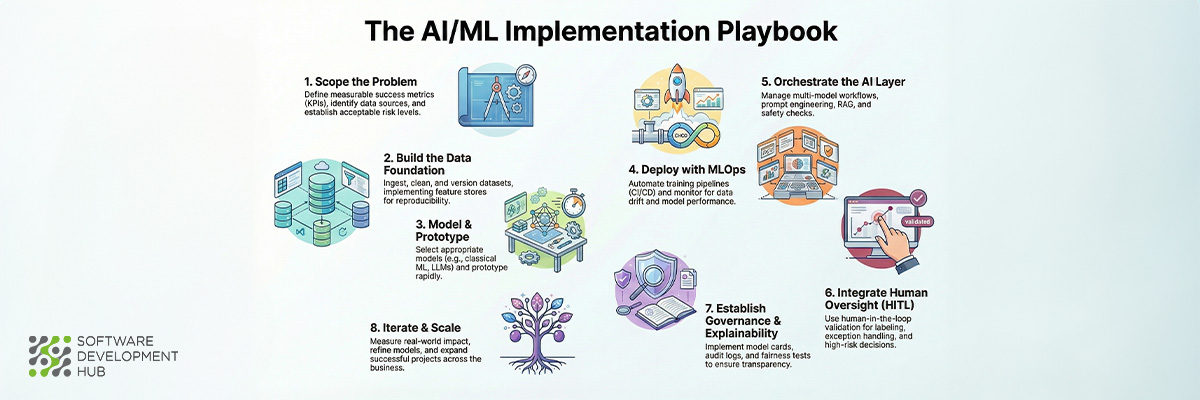
When projects call for both AI and ML, use a layered approach:
- Problem scoping & hypothesis
Define measurable success metrics (KPIs), data sources, and acceptable risk. Keep the scope modular: build a modelable piece first.
- Data foundation (the backbone)
- Ingest, clean, label, and version datasets.
- Implement feature stores and lineage tracking for reproducibility.
- Modeling + prototyping
- Choose models appropriate to the task (classical ML, deep learning, embeddings, or LLMs).
- Rapidly prototype with off-the-shelf models where suitable; fine-tune later.
- MLOps & deployment
- Automate training pipelines, CI/CD for models, monitoring (data drift, model performance), and rollback mechanisms.
- AI orchestration layer
- Wrap ML models in an orchestration layer that manages multi-model workflows, decision logic, and human approvals.
- For generative or conversational AI, implement prompt engineering, retrieval-augmented generation (RAG), content filtering, and safety checks.
- Human-in-the-loop (HITL)
- Include human oversight for labeling, validation, and exception handling—especially in generative outputs and high-risk decisions.
- Governance & explainability
- Add model cards, audit logs, fairness tests, and user-facing explanations where required.
- Iterate & scale
- Measure real-world impact, iterate on models, and expand to more business units as reliability grows.
These steps let organizations extract fast wins from ML while building the scaffolding needed for broader AI capabilities.
Which technology to pick and why
Finance — fraud detection & customer service
-
ML fit: Supervised models (transactional fraud detection) that score anomalies and flag transactions. Fast to train on labeled historical data and profitable quickly.
- AI fit: Combine ML scoring with agentic AI for automated investigation workflows and conversational bots for customer recovery. Use governance layers for compliance. Real-world finance examples show a mix of ML detection and AI orchestration.
Healthcare — diagnostic support & clinical automation
-
ML fit: Imaging diagnostics and predictive risk models (readmission risk) rely on ML for accuracy when trained on quality labeled datasets.
- AI fit: When integrating with EHRs, scheduling, or patient-facing conversational assistants, you need AI systems with strong explainability and human oversight. Regulatory and safety concerns are paramount. Recent academic and industry work emphasizes human-centric, explainable AI in healthcare.
Retail & eCommerce — personalization and content
-
ML fit: Recommendation engines and dynamic pricing use collaborative filtering and supervised models for quick personalization wins.
- AI fit: Generative AI can produce product descriptions, localized marketing content, or drive conversational shopping assistants; orchestration ensures personalization remains on brand and safe.
Manufacturing — vision inspection & automation
-
ML fit: Computer vision models detect defects on lines with high accuracy.
- AI fit: End-to-end automation requires AI systems to route results to robots, adjust workflows, and trigger human alerts.
These real-world scenarios illustrate the hybrid approach: ML provides the predictive backbone, AI manages orchestration, UX, and systemic behavior. Industry case studies and design patterns increasingly show model-centric pipelines combined with agentic layers produce the deepest business impact.
Current trends to watch
- Generative & agentic AI — driving new product categories and automation patterns; plan for human review.
- Human-centric and explainable AI — focus on fairness, transparency, and user trust.
- MLOps and model governance as standard practice — production readiness is now a competitive advantage.
- Industry consolidation and regulatory attention — safety, auditability, and compliance will increasingly shape vendor selection.
Quick checklist for your RFP (ai and machine learning development services)
- Business objectives and KPIs
- Data sources, access, and sample datasets
- Expected deliverables (prototype, production model, APIs, monitoring)
- MLOps & deployment plan
- Governance, safety, and compliance requirements
- Success metrics and SLA for performance & maintenance
- Intellectual property and model ownership terms
- Timeline and phased milestones
How SDH Can Help You
If your problem is a well-defined prediction or classification task with good historical data — for example, forecasting sales, detecting anomalies, or generating recommendations — it makes sense to begin with machine learning development services to get quick, measurable value.
That’s where SDH Global comes in as a strong partner:
- End-to-end AI & ML services — SDH Global offers both ML development and full AI software development services: from data collection and preparation, model training and tuning, to deployment, monitoring, and maintenance.
- Versatile domain expertise across industries — Whether your business is in healthcare, e-commerce, logistics, finance, education or another sector, SDH has experience building AI/ML systems adapted to different industry needs.
- Flexible cooperation models — You can engage SDH via a dedicated team, “time & materials,” or fixed-cost/flex-scope arrangements — which gives you flexibility depending on project size, risk tolerance, and business goals.
- Full cycle development, integration & support — From business analysis and feasibility, through rapid prototyping or MVP, to deployment, integration with your existing systems, and ongoing maintenance or scaling — SDH covers the full lifecycle.
- Swift time-to-value + scalable growth path — By starting with a lean ML MVP (for, say, predictive analytics or recommendation engine), you can validate business value quickly. Later — as the product and data mature — SDH can extend it into robust AI systems (conversational agents, automation, advanced analytics), safeguarding scalability, maintenance, and quality. This phased approach reduces risk while maximizing long-term impact.
In short: when you need AI and machine learning development services done right — tailored to your business needs, scalable, and flexible — SDH Global is well-positioned to guide you from strategy through delivery and beyond.
Categories
About the author

Head of Business Development at Software Development Hub, specializing in driving growth through strategic sales initiatives and partnerships. With deep expertise in the psychology of sales, this professional excels in developing and executing business strategies that resonate with clients and foster lasting relationships.
Share






Need a project estimate?
Drop us a line, and we provide you with a qualified consultation.